






SEJournal Online is the digital news magazine of the Society of Environmental Journalists. Learn more about SEJournal Online, including submission, subscription and advertising information.
April 29, 2026
 |
SEJ News: #SEJ2026 Live — Coverage of Conference Tours
A team of early-career freelance journalists joined SEJournal’s editors to report on the April 16 day-long tours at the annual Society of Environmental Journalists’ conference, which took place April 15-18, 2026, in Chicago, Illinois.
We’ve posted all eight tour reports in two parts, first in our April 22 edition and then in our April 29 edition of SEJournal. Explore the reports below.
- Steel at a crossroads tour — By Meg Duff
- Distributed energy tour — By Nathaniel Eisen
- Crops for climate tour — By Nhung Nguyen
- Midwestern ag systems tour — By Marlowe Starling
- Chicago environmental justice tour — By Tina Deines
- Indiana Dunes tour — By Julie Zenderoudi
- Nachusa Grasslands tour — By Madeline Shaw
- Chicago wastewater tour — By Emma Schneck
- View a slideshow of tour photos
 |
The #SEJ2026 Live initiative comprised eight early-career freelance journalists — Emma Schneck, Julie Zenderoudi, Madeline Shaw, Marlowe Starling, Meg Duff, Nathaniel Eisen, Nhung Nguyen and Tina Deines — working with SEJournal editor Adam Glenn.
Additional editing provided by Frances Backhouse, associate editor, with copy editing by Cindy MacDonald and production by MJ Davis.
Many thanks to the SEJ’s Aparna Mukherjee, executive director, for her encouragement and financial backing of this initiative, and to Jingyao Yu, director of operations and engagement, for her logistical support.
All stories and images are available open-source for other outlets and organizations to share and republish, with credit and links. Material for this coverage was drawn from tours organized by the Society of Environmental Journalists at its annual conference in Chicago, Illinois, in April 2026, whose sponsors are listed here.
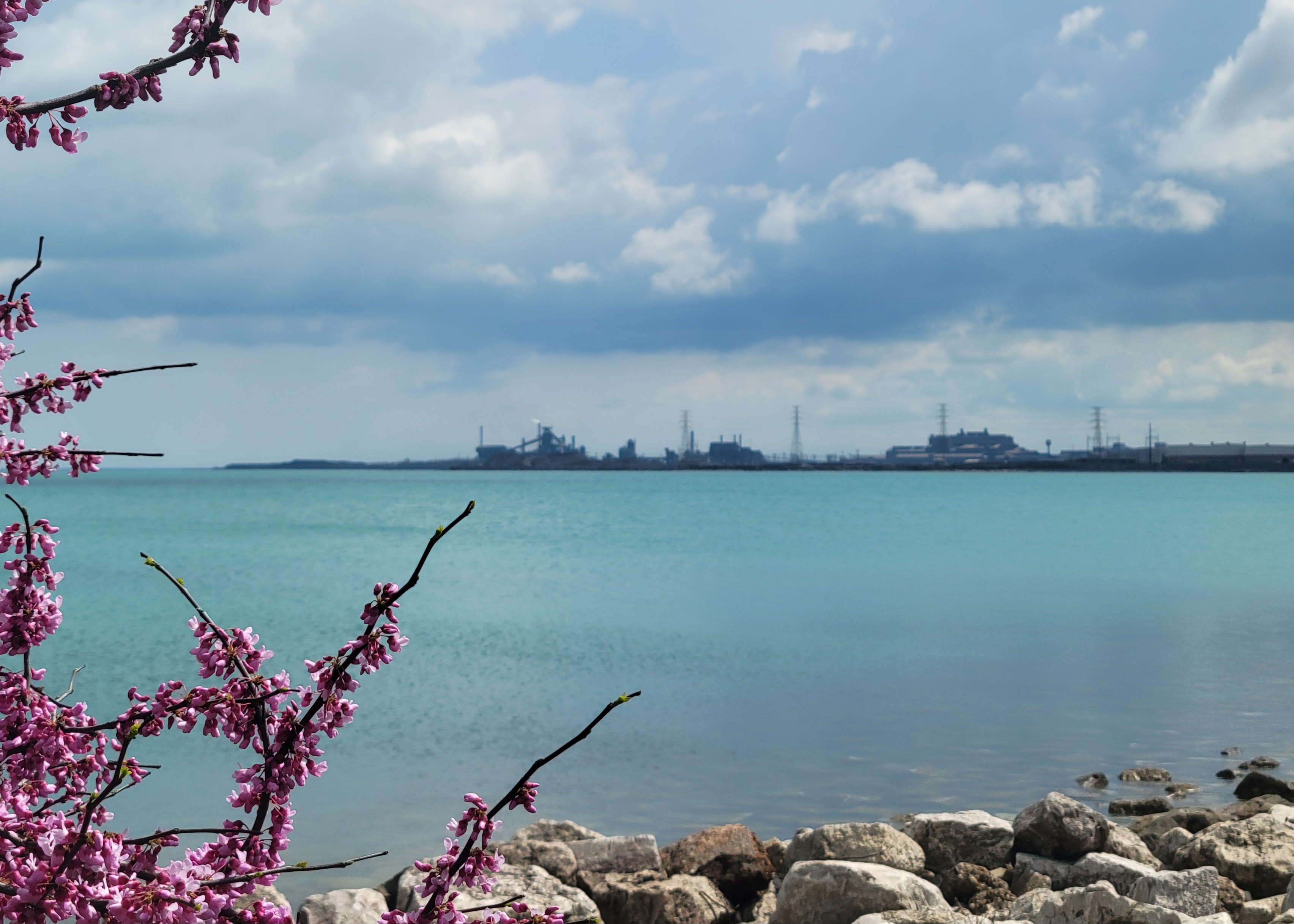 |
| The Indiana Harbor steel mill, owned by Cleveland-Cliffs, is one of three integrated steel mills in Northern Indiana that refine iron and then make steel using coal. Photo: Meg Duff. |
Northern Indiana Organizers Seek Hail Mary for Steel Mill Decarbonization
Will one of the few remaining coal-fired steel plants change course to a cleaner technology to protect health, jobs and the climate?
By Meg Duff
On the roof of a Gary, Indiana, parking garage, Jack Weinberg waved his cane at steam rising from a teal structure on the horizon: the Gary Works steel mill, where Weinberg once worked.
In December 2025, U.S. Steel announced that it would reline one of the coal-fired blast furnaces there, a project that could keep the furnace online for another 20 years, according to company statements.
The Chicago Tribune reported in February that this process could begin as soon as May. But Weinberg, an adviser for the grassroots group Gary Advocates for Responsible Development, hopes U.S. Steel and its owner, Nippon Steel, will change course.
GARD members want the company to invest in cleaner technology instead, to protect health, jobs and the climate. They worry that if companies double down on coal now, they may leave northern Indiana behind as they pursue more modern techniques elsewhere.
On a 2026 Society of Environmental Journalists’ conference tour organized by journalism nonprofit Canary Media, community advocates explored the case for decarbonizing steel production at steel mills like Gary Works. U.S. Steel declined to participate.
Over the last half-century, much of the steel industry shifted to recycled steel. Gary Works and six other U.S. steel mills, however, still make steel from scratch, using coal.
Their “primary” steel is often used in products like car frames and I-beams, which have strict requirements for composition and strength that recycled steel can’t typically meet.
The promise of direct-reduced iron
On the bus ride from Chicago to Gary, Ariana Criste, deputy communications director for Industrious Labs, said coal-based steel contributes to climate change and premature deaths. Criste said healthier, lower-carbon alternatives can already replace coal-based primary steel.
Direct-reduced iron furnaces, widely used since the 1970s, can produce iron for primary steel using natural gas or green hydrogen. That iron can then feed the electric arc furnaces also used to produce recycled steel.
GARD would like U.S. Steel to invest in direct-reduced iron at Gary Works rather than relining the blast furnace. The company, meanwhile, told the Tribune that GARD’s proposed solution underestimates the full cost of such a transition.
But Criste said that direct-reduced iron using green hydrogen can be 70% less carbon-intensive than coal-based iron production, and there is rising demand for such steel from companies with climate targets.
This approach can meet the same quality needs as coal-based steel, Criste said, and the iron can also be shipped before being made into steel. That recent development could reduce the need for integrated steel mills like Gary Works that make iron and steel at the same location.
“It's not about whether the technology works or if the market is moving. Those questions have been answered,” Criste said. “The question left over is whether the communities that have carried this industry for over a century will be part of that future or left behind.”
Is the future of steel production elsewhere?
As the tour bus pulled up to a park on the shore of Lake Michigan, pink-blossomed trees framed a view of another northern Indiana steel mill: Indiana Harbor, owned by Cleveland-Cliffs.
Cleveland-Cliffs planned to invest in direct-reduced iron production at a facility in Ohio using Biden-era clean energy incentives from the Inflation Reduction Act, but those plans were reversed in 2025, according to reporting by Canary Media.
In front of Indiana Harbor’s sprawl of buildings and blast furnaces, Terry Steagall, a retired Cleveland-Cliffs employee now organizing with GARD, said when steelmakers choose to double down on coal, they are signaling that the future of steel production lies elsewhere.
“That’s not a long-term plan, really, for the steel industry. That’s a 20-year shutdown plan,” Steagall said.
An April report from Indiana University found that sticking with coal-based steel production in northwest Indiana could risk 12,000 related jobs by 2034, with fewer losses from a transition to direct-reduced iron and electric arc furnaces.
Megan Robertson, executive director of Indiana Conservation Voters, whose grandparents worked in steel mills, told tour attendees that many steel companies are building their cleaner steel operations in Southern states with looser labor laws, rather than using existing sites in northern Indiana.
“This industry was built on Terry's back and knees, and on my grandpa's back and knees,” Robertson said. “But they're not investing here to take us to the next phase.”
Back on the bus, Roger Smith, Asia lead at the climate-focused group SteelWatch, explained that U.S. Steel already has a next-generation steel mill in Big River, Arkansas. It already uses electric arc furnaces and plans to invest in direct-reduced iron furnaces as well.
Smith believes Nippon, which faces decarbonization mandates in Japan, bought U.S. Steel in part to learn new techniques from Big River — but that doesn’t mean that Nippon will decarbonize at Gary Works.
“It’s a very conservative company. This is a company that built its global success on coal, on blast furnaces, and it’s very reluctant to change course,” Smith said.
Can organizers change trajectory?
Arriving in downtown Gary, the bus passed a towering statue of steelworkers feeding a furnace. Community members and organizers joined journalists for a lunch of jerk chicken and coleslaw.
Mike Oles, Indiana organizing director for environmental group Mighty Earth, says one way to change company trajectories is for union members to take big risks — but said such campaigns are the exception, not the norm.
He pointed to an Indiana factory closure that workers successfully reversed because they were willing to give up substantial severance payments if their efforts failed.
After lunch, the crowd moved to a nearby rooftop to get a good look at Gary Works, with Weinberg explaining that keeping northern Indiana steel mills operational could postpone costs related to decommissioning — although cleanup requirements could be stronger.
“If they were forced to pay the cost of remediation, they would much rather modernize,” Weinberg said.
Jack Bittle, a reporter at Grist who attended the tour, said he appreciated the opportunity to discuss the financial complexities of decarbonization with community members.
“I was really grateful to have the opportunity to learn about just how nuanced and difficult the decarbonization of such a critical industry really is,” Bittle said.
Even recycled steel itself is no panacea. Tour attendee and recent SEJ top investigative award winner Erin McCormick commented, “It’s a matter of doing things right” with any approach.
McCormick also wondered about another decarbonization strategy that didn’t come up: reducing demand for primary steel in the first place.
“Is there a world where we use less steel?” she asked. “We didn’t quite get that perspective, but I bet that’s there too.”
Meg Duff is a freelance journalist and audio producer reporting mostly on climate change, who also edits and fact-checks. She graduated from New York University with an MFA in literary reportage. Find her work at megduff.com.
 |
| Mohammad Shahidehpour, at center front, demonstrates a model of the microgrid on the Illinois Institute of Technology campus. Photo: Nathaniel Eisen. |
Microgrids Are a Tool for Resilience. What About Shifting Power?
For Chicago’s Bronzeville area, energy transition comes against backdrop of displacement and disinvestment
By Nathaniel Eisen
In a historic Chicago neighborhood that once earned the nickname “Black Metropolis,” the future of energy is taking root.
“Our story is the story of the Great Migration,” said Billy Davis, executive director of the Bronzeville Community Development Partnership, referring to the mass movement of Black Americans in the late 19th and early 20th centuries from the South to northern cities, which spawned a period when Bronzeville became a hub for Black culture, business and community.
Davis was speaking about the past and future of energy in Bronzeville to a group of reporters and green energy professionals attending the 2026 Society of Environmental Journalists’ conference.
Bronzeville hosts the first cluster of microgrids (may require subscription) — areas integrated into, but able to separate from, the larger electrical grid and produce their own power — in the world.
But the construction of these microgrids and the “smart grid” of which they are a part — which also includes smart meters and appliances, distributed renewable generation, electric vehicles and battery storage — takes place against a legacy of historic disenfranchisement, displacement and disinvestment whose echoes still reverberate.
Residents, the local utility and local leaders are actively working to flip the script, along with the switch.
Avoiding power loss, creating savings
Commonwealth Edison, the investor-owned utility providing power to over 1 million customers in northern Illinois, proposed the Bronzeville Microgrid in 2016. Conceived as a pilot, final construction and testing finished in 2024, at a total cost of about $30 million.
The microgrid covers a small yet strategic 0.31-square-mile section of Bronzeville containing the headquarters of the Chicago police and fire departments and several schools. Yet it connects to an earlier microgrid constructed on the Illinois Institute of Technology campus.
According to Mohammad Shahidehpour, director of the Robert W. Galvin Center for Electricity Innovation and an architect of the IIT microgrid, the two microgrids together serve a peak load of about 22 MW. Some solar generation and battery storage have been constructed at IIT, and on and adjacent to Dearborn Homes, a public housing complex in Bronzeville.
But the bulk of the power supply comes from a fossil gas (also referred to as natural gas) plant on the IIT campus and from mobile fossil gas generators. Together, these resources would provide all buildings connected to the two microgrids with power in the case of a wider blackout.
Bronzeville’s mix of municipal, public safety, education and health care services, as well as residential and commercial buildings, makes it “an ideal example of the diverse needs of resiliency in critical support life services,” according to Bruce Montgomery, president of the board of the Bronzeville Black Metropolis National Heritage Area. This helped convince elected officials and utility leaders to pilot the clustered microgrid concept there.
And while the main benefit of the microgrid is resiliency, avoiding power loss and hosting in-district generation also creates savings. Shahidehpour estimated the IIT microgrid saves the university about $1 million per year. The solar installation at Dearborn Homes, though not owned by the Chicago Housing Authority, sells power to the authority for about 75% less than normal retail rates.
Residential disconnections still a problem
Yet the microgrid is clearly not a panacea. A ZIP code making up much of Bronzeville had one of the highest percentages of involuntary residential disconnections in areas served by ComEd in 2024, according to a report from the utility regulator.
And residents of Lake Meadows Apartments, a Bronzeville development just outside the boundaries of the microgrid, are currently demanding that ComEd upgrade aging transformers they say don’t allow for adequate air conditioning in their homes.
Sherelle Withers grew up in a different housing complex in Bronzeville, before she says a lack of investment in shared infrastructure made life there untenable, contributing to the dissolution of a community she remembers fondly.
“You could ride your bike down the hall to the neighbors, who were just like the extended family. And if you went too far, you know, somebody would call you and say, ‘You know your mom wouldn't let you go down this far,’” she said.
Now, equipped with an advanced degree in urban planning and decades of experience in both the public and private sectors, she hopes an organization she co-founded and directs can help residents of Bronzeville take greater control over building the next phase of the smart grid.
The group, known as the “Innovation Metropolis Smart Tech District,” has multiple goals. One is to acquire and transform a building across from the Bronzeville Community Development Partnership headquarters into a hub for all things clean energy. It will include room for educational exhibits, retail kiosks, offices and green manufacturing.
Another goal is to serve as an intermediary between ComEd and residents of Bronzeville, helping residents better understand the technologies that comprise and are enabled by the smart grid and take ownership of building its next phase.
‘Talking about having a seat at the table’
Withers is pushing ComEd to give a community advisory group that meets quarterly a greater say in decisions, as well as to collect and provide access to data on key indicators of interest to community members.
“When you're talking about having a seat at the table, and you're trying to bring together community, recognize that that table is in their house,” Withers said.
And as both the IIT and Bronzeville microgrids (and their linkage) serve as technological templates for other universities and communities, issues around local decision-making deserve equal consideration.
For its part, ComEd says it has learned from the experience. “Key lessons from the Bronzeville Community Microgrid include the importance of early cross-functional coordination, rigorous real-world validation of controls, protection, and communications, and thoughtful integration of infrastructure within dense urban neighborhoods,” wrote Communications Manager David O’Dowd.
Tour participants expressed appreciation for the way the tour focused as much on the experience of technology as on the technology itself.
“I felt like that was a really important message we got from Sherelle was the human side of all this technology,” said Lindsey Samahon, communications director at the Kleinman Center for Energy Policy at the University of Pennsylvania.
“It’s easy to get gummed up in the systems,” Samahon added, but “when we talk to policymakers, we’re trying to help them understand how all this matters to their constituents.”
Nathaniel Eisen is a climate journalist based in Burlington, Vermont. They write about climate and energy policy and politics in New England, and their work has appeared in Inside Climate News, Washington City Paper, Governing.Com and Stanford Magazine. They hold law and public policy graduate degrees from New York University School of Law and the Harvard Kennedy School of Government.
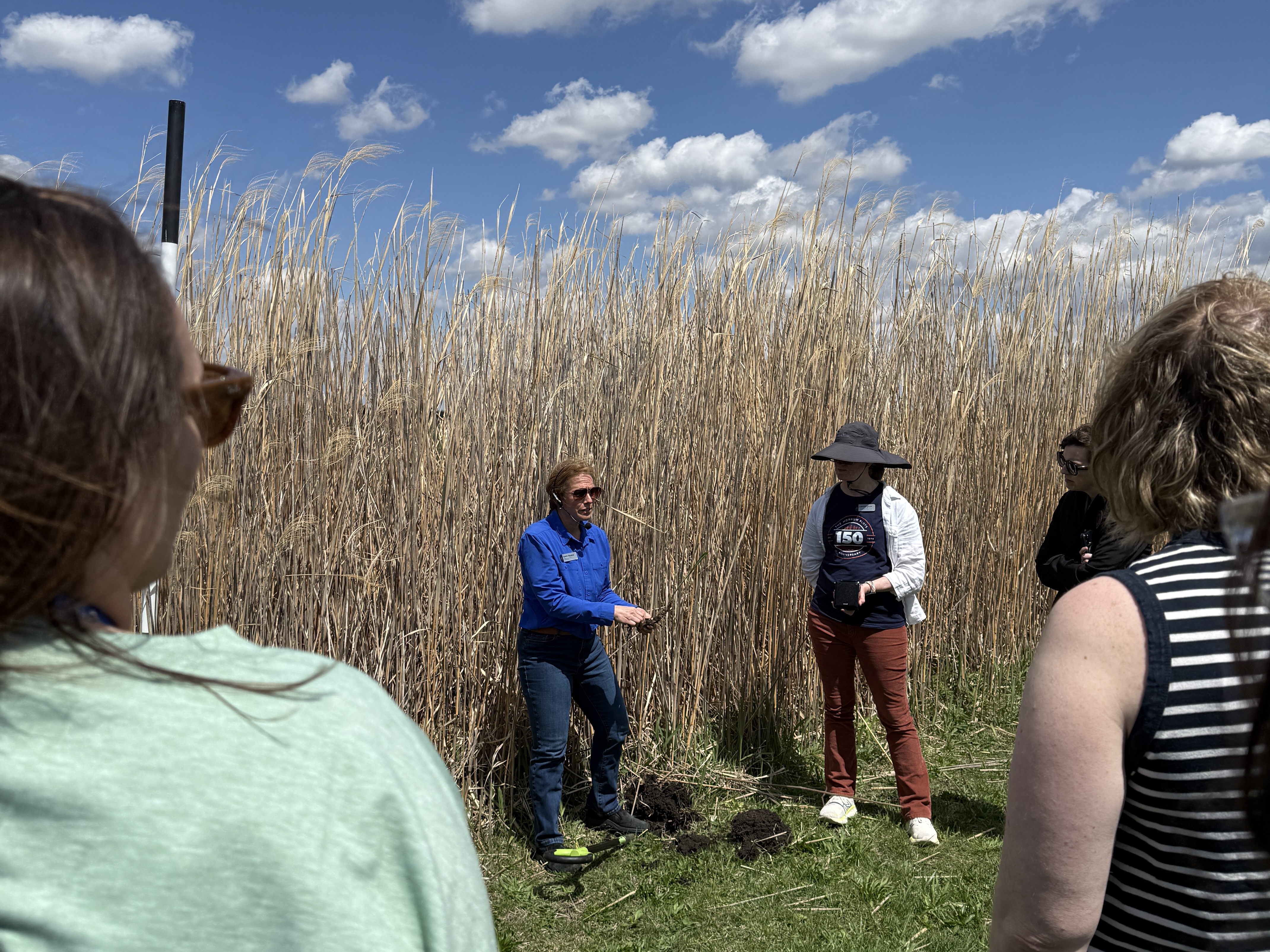 |
| With her back to a dense stand of miscanthus, Emily Heaton, at center, in blue, stood at the Energy Farm on the University of Illinois Urbana-Champaign campus, where researchers are testing biomass crops for climate solutions. Photo: Nhung Nguyen. |
Test Beds for a Climate-Changed Farming Future
Illinois, with agriculture powering a $51 billion industry, is both a major greenhouse gas emitter and an unlikely proving ground for a climate-resilient future of farming
By Nhung Nguyen
On a warming planet, agriculture is both one of the earliest victims of climate change and one of its biggest contributors.
In the opening months of 2026, farmers across the country have already grappled with an array of extreme weather events, from a blizzard and ice storm burying vegetable farms in Michigan to an epic drought gripping the Great Plains.
At the same time, feeding a growing population means more nitrous oxide emissions from fertilizers, more methane from livestock and more land put under strain. Recent federal government figures show agriculture accounting for a tenth of U.S. greenhouse gas emissions.
The question is no longer whether agriculture must change, but how quickly, and where those changes can be tested at scale.
Few places are better positioned for that experimentation than the University of Illinois Urbana-Champaign. Set in the heart of one of the most productive agricultural regions in the world, the university functions as a kind of “living laboratory,” where the future of farming can be prototyped, stress-tested and refined.
Miscanthus, an up-and-coming bioenergy source
On a recent sunny April day, Emily Heaton, a professor of crop sciences at the University of Illinois, showed visitors around the Biomass Innovation Hub, a center dedicated to developing a biomass-to-manufactured product ecosystem for miscanthus — a towering grass that could reshape the agricultural landscape.
“We have North America's only large miscanthus breeding program here” not supported by the United States Department of Agriculture, Heaton said. By 2035, they aim to be growing 10,000 acres of miscanthus near the University of Illinois area.
A relative of sugarcane, the crop grows densely and several feet tall, producing high yields of fiber mass for animal bedding, agricultural mulch, compostable packaging, bio-sourced construction materials and — most important of all — bioenergy.
While ethanol from cornstarch is currently one of the most important sources of biofuels in the United States, recent studies suggest that miscanthus could serve as a nongrain alternative that will not drive up corn prices and threaten food security.
And unlike traditional row crops, miscanthus can help restore soil health and sequester carbon.
“This is arguably the most altered landscape in the world, from the undersurface drainage that we've put in the Midwest landscape,” said Heaton.
Illinois, a top producer of soybeans, corn and livestock at massive scale, has borne significant climate costs. Millions of metric tons of greenhouse gases are emitted each year, largely from fertilizer use and livestock, while soil erosion and runoff are pushing farmers to adopt practices like cover crops and no-till to reduce impacts.
Miscanthus, meanwhile, thrives for years without replanting or tilling. “It harbors a host of microorganisms and macros,” Heaton said, pointing at a hole she just dug in a trial plot, where worms wriggled. “Soils are getting healthier, because the plants are putting sugars into those microbes below ground.”
Heaton and her colleagues grow a sterile variant of the non-native grass that produces no seeds, but spreads through underground stems.
“It is taking carbon dioxide from the atmosphere,” Heaton said, “and recycles its nutrients each year, with these rhizomes as storage organs. So the fertility demands of this crop are very low.”
The promise of agrivoltaics
Just steps away from the dried grassy patches, another vision of farming’s future is being tested.
An 88-kilowatt agrivoltaic system has been installed along the edge of the 320-acre Energy Farm, its rows of solar panels elevated six feet above the ground and spaced widely.
“This year, we're planting soybeans and sorghum,” said Bruce E. Branham, a professor of horticulture at the University of Illinois. His team is piloting agrivoltaics — a practice incorporating solar panels into cropping systems — by growing row and forage crops directly under and between the panel rows.
“[Farming] has been very economically challenged these last few years,” said Branham. “It's hard to make a living growing our corn and soybeans. This offers a way to get much more income off the land.”
He estimated farmers could earn $1,000 to $2,000 an acre from agrivoltaics developers, “whereas with corn and soybeans, you're looking at $120.” But adoption of this new system has been slow, in part because farmers need clearer economic incentives and proven models.
Early findings are nuanced. Their conclusions so far are that while agrivoltaics is possible, it’s hard to do in tandem with Illinois’ traditional farming. “With very large equipment, we need very wide spacing,” Branham said. “It becomes uneconomic for the panels.”
On the other hand, forage crops prospered, so the easiest way to integrate agriculture with solar infrastructure may be through raising grazing animals. “Particularly sheep,” Branham explained, “because they won't do a lot of damage.”
Illinois’ storms and tornadoes do pose risks to the installations, Branham said, though engineering fixes are being developed elsewhere. AI and weather predictions, together with solar systems designed to tilt and turn into the wind to avoid the uplift effect, could minimize “the worst of the injury,” he said, “but there's really not a lot you can do.”
Cultivating plant-based proteins
On another part of the university’s land, 10 minutes drive from the outdoor “living lab,” the focus is on reimagining what agriculture produces.
Soybeans and corn are widely grown by Illinois farmers and some of them are now becoming plant-based protein sources. Home to more than 30 companies (requires subscription) producing plant-based, fermentation and cultivated products, the state is emerging as an alt-protein hub.
This shift could offer another climate-resilience tool. A 2024 Nature study found animal-based foods generate more emissions than plant-based foods, despite providing fewer calories, and that moving toward plant-based proteins would reduce the global agriculture footprint the most.
Yet, the evolving industry still faces a bottleneck: a gap between small-scale lab research and full industrial production.
“It seemed like a really silly problem,” said Beth Connerty, Urbana-Champaign professor of food and bioprocess engineering and the executive director of the university’s Integrated Bioprocessing Research Lab. She pointed at the global and national lack of midscale infrastructure. “If we can drive innovation, if we've got manufacturing partners, why is Illinois sending these companies to Europe, to Southeast Asia, to India, to do that development work?"
To close this gap, millions of grants and support from federal and state funding have been invested into IBRL and the Illinois Fermentation and Agriculture Biomanufacturing Tech Hub. By serving as a shared-use facility, they allow startups and researchers to test specialized equipment and expertise without the cost of private equipment.
The goal is to de-risk new technologies: precision fermentation systems that use engineered microbes to produce everything from sustainable fertilizers and biodegradable textiles to the most well-known alternative proteins, like fake meat and egg white powder.
Their clients do their fermentation in stainless steel reactor tanks that range in size from 20 liters to 1,500 liters, and permeate the air of the facility with yeasty and moldy smells that one visitor described as being “between yum and ugh.”
“We're averaging four to five different projects per week,” Connerty said. “It is very much addressing this middle stage of development and what we're calling a lab-to-line.”
The ambition extends beyond individual products. “We are really about expanding food options,” Connerty said, “about making a more resilient and robust food supply chain, and about giving consumers more options.”
Plants as a key lever to address climate change
Taken together, these initiatives illustrate what a test drive for climate-resilient agriculture looks like: rarely a single breakthrough, but a portfolio of experiments, and each addressing different facets of the same challenge.
The stakes are enormous. Illinois is currently leading the country as “the new severe weather champion.” So far in 2026, it has topped the charts for unusually high numbers of tornadoes, hail events and windstorms.
“If you want to influence atmospheric carbon dioxide rates, plants do that, faster than anything else,” said Heaton. “They're the only large-scale mechanism we have to reduce atmospheric CO2.”
“And if you want to access lots of plants, you go to agriculture,” she added. “This is probably one of the single biggest levers we have to pull to fight climate change.”
Nhung Nguyen is a freelance journalist from Vietnam who covers climate change, labor, public health and the environment. She is currently based in New York to complete her master's degree at NYU in the science, health and environmental reporting program.
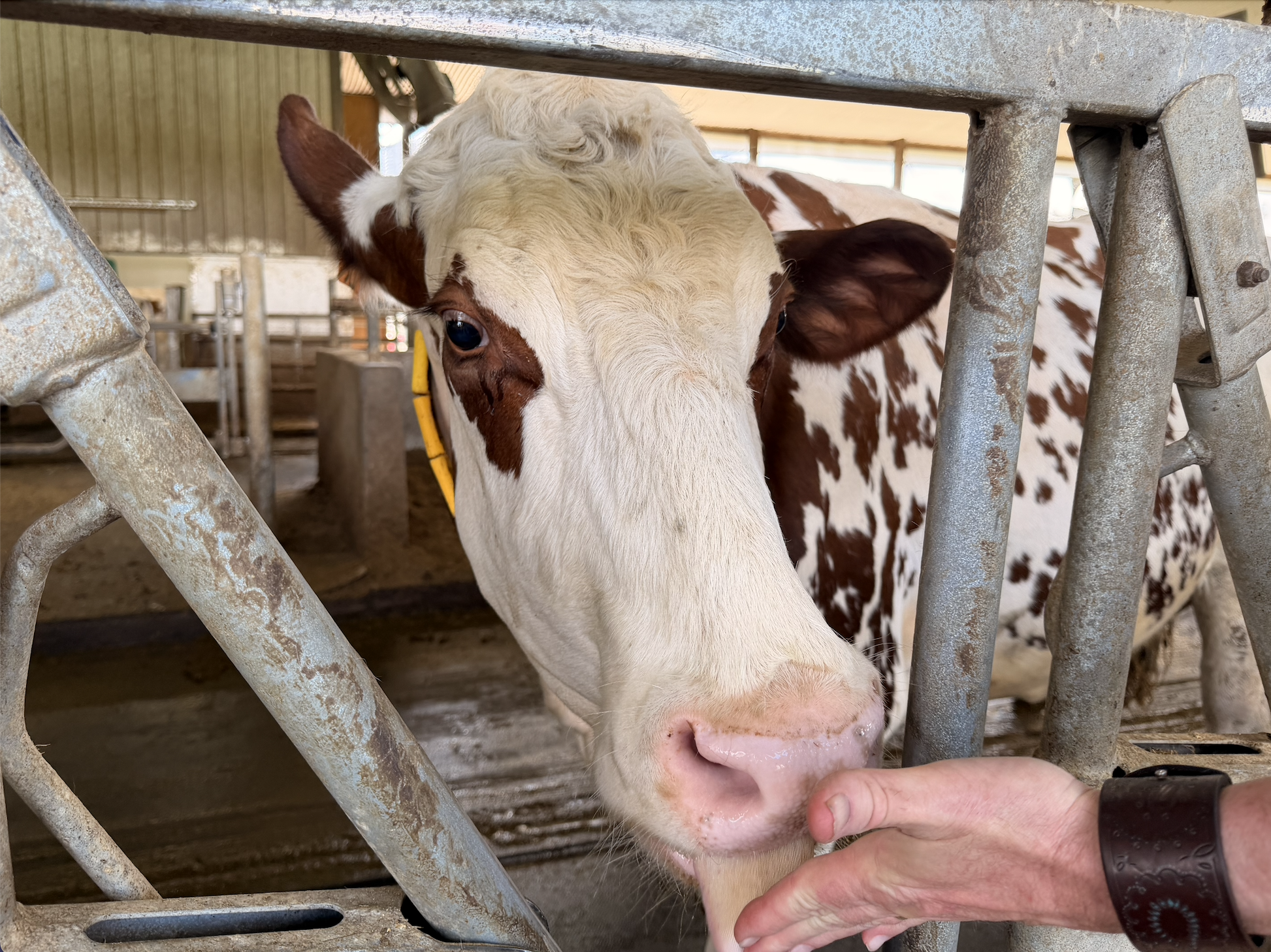 |
| A cow at the Lenkaitis dairy farm, which uses automated milking machines to better monitor cows’ health, gives a lick to the hand of an SEJ tour attendee. Photo: Marlowe Starling. |
From Cows to Corn, How Illinois Farmers Are Conserving Resources
Innovative farming practices help farmers reduce agriculture’s environmental impacts while increasing their resilience to financial challenges and climate uncertainty
By Marlowe Starling
Jim Robbins’ farm is anything but old-school. He and his nephew, fourth- and fifth-generation farmers, grow corn and soybeans on 5,000 acres of land in Will County, Illinois, where they are some of the few farmers who are implementing technologies that reduce runoff and nutrient pollution while improving yields.
At a glance, Robbins’ fields look a little different from the others. Farm rows alternate between light and dark in color due to strip tilling, in which only narrow, 7-inch rows are tilled for crops. This technique minimizes soil disturbance and reduces fertilizer loads, since fertilizer can be applied to crops more precisely.
“The corn plant can utilize it right away,” Robbins said during the #SEJ2026 conference’s ag systems tour, led by Associated Press reporter Melina Walling.
The practice has also improved his yields. “When I started farming, if we got 150 bushels of corn, we were lucky,” Robbins said. “Now, we get, hopefully, 250 bushels. We've doubled it in 46 years.”
Reducing agriculture’s environmental footprint
Robbins’ farm was the first of two stops where tour participants learned how farmers in the Midwest can minimize agriculture’s environmental footprint and the obstacles to doing so.
For example, to keep the soil healthy and reduce erosion during offseasons, Robbins plants cereal rye after the corn harvest as a cover crop.
He also rotates between growing corn and soybeans from year to year. That “keeps the bugs at bay,” he said, allowing him to keep herbicide and pesticide use to a minimum.
Then, there’s the technology.
Gargantuan seed planters, tractors and tillers can span 12 rows of crops and orient seeds in the most optimal direction for more efficient growth.
Below ground, tile drainage pipes discretely remove excess water to avoid runoff into nearby waterways — rivers that ultimately dump into the nutrient-overloaded Gulf of Mexico.
Financial realities of farming
Megan Dwyer, a fellow farmer and a lobbyist with an advocacy group called IL Corn, helped reporters better understand policy and funding structures.
With very little state or federal funding, rampant tariffs, higher diesel and input costs due to war in Iran, and an undecided Farm Bill, farmers like Dwyer and Robbins depend on cost-sharing programs and private funding to offset expenses. A single tractor on Robbins’ farm costs around $250,000.
Given these high financial burdens, journalists were eager to understand why farmers like Robbins employ conservation strategies at all, even when they aren’t required.
“A farmer is always an optimist,” he said. “We have to be. You're putting a seed in the ground, and hopefully in the fall, we're going to harvest that.” Plus, he added, weather patterns are changing; farming more efficiently helps reduce costs and risks.
Dealing with the smelly stuff
The tour also visited a dairy farm owned by Sarah and Andy Lenkaitis — one of the few in the country using automated-milking machines that can better monitor cows’ health than humans alone.
One of the biggest challenges of running a dairy farm is the smelly stuff. By storing the manure in a 600,000-gallon pit beneath the barn, which Andy Lenkaitis built himself, and separating liquids from solids using a “digester,” the Lenkaitises are able to minimize odors for their neighbors, while creating a free (and recycled) form of fertilizer for the cover crops they grow as feed. They use 100% of their cows’ manure on their fields.
Attendees also learned how the dairy industry can scale back its methane production despite inevitable emissions from cow burps.
High-tech options to help cows produce less methane in their guts include compounds and selective breeding, explained a scientist with Dairy Checkoff, a farmer-funded program that supports dairy research.
In the short-term, she said, using a digester — such as the one at the Lenkaitis farm — to separate the liquid from the solids (which then become compost) does a lot to mitigate methane release from farms.
A backstage pass
“It's really important that people get out here and see what farmers actually do,” said tour participant Katie Shealy, a University of Florida environmental journalism student who grew up on a cattle farm in Wewahitchka, Florida. “We get disconnected from how our food is made.”
For Gabrielle Nelson, an environment reporter with the Mississippi River Basin Ag & Water Desk, the tour was an opportunity to do one of her favorite things: talking to farmers.
Nelson, Monica Cordero-Sancho and Cassandra Stephenson collaborated on a story late last year for Tennessee Lookout about how tariffs and insufficient federal aid have affected soybean farmers’ profits.
The SEJ tour offered a glimpse into a part of agriculture that isn’t seen as often, Nelson said. “I really wanted to get a backstage pass.”
“I didn't know much about agriculture before I started reporting on it,” Nelson added. “This has been really good insight, and I'm definitely going to be able to use this in my future reporting.”
Marlowe Starling is a freelance environmental journalist based in Brooklyn, N.Y., who writes about climate, conservation and coastlines. Her work has appeared in National Geographic, The New York Times, CNN, Forbes, The Guardian, Quanta Magazine, Sierra Magazine, Mongabay and more. She earned her master's degree in science journalism from New York University and her bachelor's degree in journalism with a specialization in wildlife ecology from the University of Florida.
The Pepsi ExplosionA couple of surprises did greet our tour, one of three daylong outings that were sponsored as part of an SEJ pilot for this year’s conference. While tour attendees were made aware at registration of the sponsorship by Environmental Defense Fund, a nonprofit environmental advocacy group, they learned upon arriving on the tour bus that there was another co-sponsor listed on the information materials distributed on the bus: PepsiCo. The multibillion-dollar food and beverage company is well-known for its widespread environmental degradation and greenwashing tactics, so that didn’t sit too well with some attendees. When Delger Erdenesanaa, a reporter at Chemical & Engineering News, asked for clarification about what the sponsorships entailed, EDF communications manager and tour co-leader Austin Matheny-Kawesch only offered that they “made the tour possible” and did not provide details. To add insult to injury, Jeremy Adamson, a Pepsi representative and surprise speaker on the tour, even replaced SEJ-provided snacks and drinks with Pepsi products. "We didn't know about PepsiCo's sponsorship until we were already on the bus and offered Gatorade water bottles," said Emily Payne, a freelance journalist based in Denver. "It was an instructive tour, but as journalists, seeing the sponsorship prior to signing up may have impacted our choice to attend." SEJ Executive Director Aparna Mukherjee told SEJournal in an email that EDF was the only listed (and official) partner on SEJ’s tour list because it was the only source of funding directly to SEJ for the $5,000 cost of the tour. Mukherjee added that while she saw a Pepsi speaker on the schedule she wasn’t aware that Pepsi was listed as a “sponsor” on the tour pamphlets until after the tours concluded. She agreed that the sponsorships should have been clearer up front, and that if SEJ decides to pursue sponsored tours in the future, there should be stronger guardrails. Mukherjee also clarified that sponsorship for tours was a selective process and that having them marked as sponsored “was one of the biggest pieces,” noting that sponsored tours have been mainstream at other science journalism conferences. “Raising the transparency issue was very important to me.” That wasn’t the only unexpected development. Just as everyone settled in for a post-tour nap en route back to Chicago, a sudden burst of color and smoke interrupted the sleepy silence. Bright orange coolant exploded into the bus when a pipe burst, spraying those seated nearby, then issuing plumes of smoke. With flawless composure, however, the University of Illinois Chicago bus driver brought us to a safe stop on the side of the highway, allowing attendees to promptly evacuate. Tour leader Walling quickly corralled the group, devised an ad hoc plan and organized groups of four to split Ubers for the remaining hour-and-a-half drive to UIC Forum, just in time for the close of the hospitality reception. — Marlowe Starling |
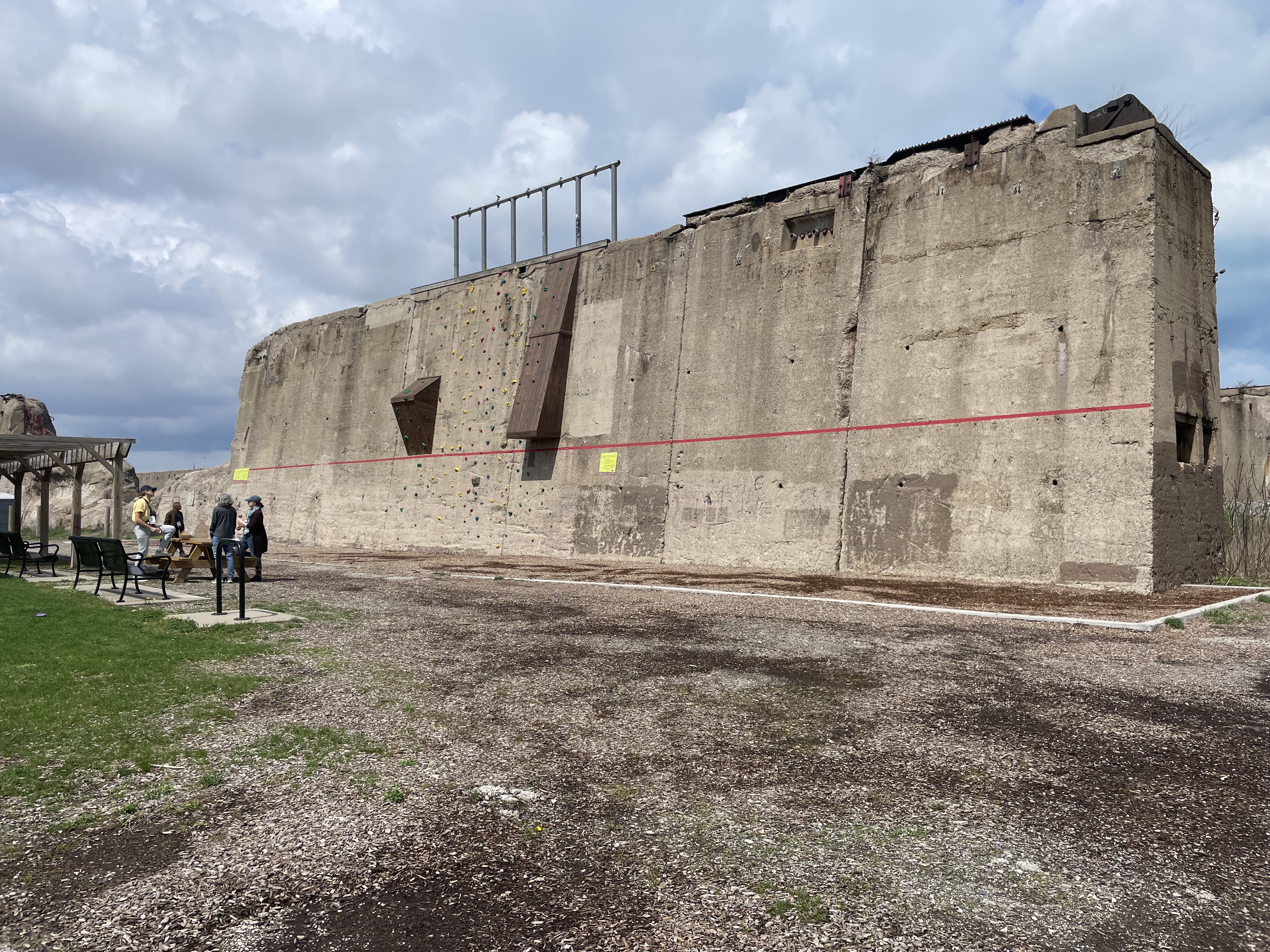 |
| A remnant of U.S. Steel's South Works mill, which has been converted into a rock climbing wall at Chicago’s Steelworkers Park. Photo: Tina Deines. |
Toxic Doughnuts, Sulfur Piles and Slag
#SEJ2026 attendees get crash course on Chicago environmental justice tour
By Tina Deines
Lake Michigan’s seemingly endless expanse of emerald blue water serves as a backdrop for Steelworkers Park on Chicago’s South Side. Gulls and geese call out, as locals fish on rocks below.
But all is not as it seems. Just to the west are the ruins of U.S. Steel's South Works mill, which closed in 1992. The concrete slabs that remain are now adorned with graffiti and a small rock-climbing wall.
Meanwhile, the rumble of heavy equipment behind this open space — the future site of the Illinois Quantum and Microelectronics Park — blends in with waterfowl’s vocalizations.
The park was one of several stops during the #SEJ2026 conference’s Chicago environmental justice tour. The event was led by Brett Chase, a Chicago Sun-Times reporter and assistant editor, and Gina Ramirez, director of Midwest Environmental Health for the Natural Resources Defense Council and an active member of the Southeast Environmental Task Force, a Chicago nonprofit.
Cheryl Johnson, executive director of the grassroots group People for Community Recovery and daughter of Hazel Johnson — known as the “mother of environmental justice” — also spoke.
‘Dumping grounds for industry’
Chase began the tour with a brief history of Chicago’s environmental justice concerns, based on his years of work as an environmental reporter for the Sun-Times.
“The West Side and South Side have long been the dumping grounds for the industry,” he said. “This whole area wasn’t built for residents; it was built for industry.”
The group began its visit at Altgeld Gardens housing complex in the far Southeast Side, where the predominantly Black community has faced ongoing environmental hazards over the last half century. This is where Hazel Johnson started her environmental justice work and where her daughter continues those efforts today.
Altgeld Gardens is surrounded by industrial sites, landfills — Hazel Johnson’s work documented at least 50 of them in the area — and incinerators, which have caused elevated levels of pollutants such as heavy metals and pesticides.
“We label our community as the toxic doughnut,” Cheryl Johnson said, referring to a phrase of her mother’s.
Cheryl Johnson also talked about plans to revitalize a deteriorating building that once served as a school and community hub, and convert it into the Hazel M. Johnson Institute for Sustainability and Environmental Justice.
According to Cheryl Johnson, it would be the first institute focused on environmental justice based in a predominantly low-income and minority public housing project. Funds of $20 million would need to be raised for the initiative.
‘The taste of sparklers’
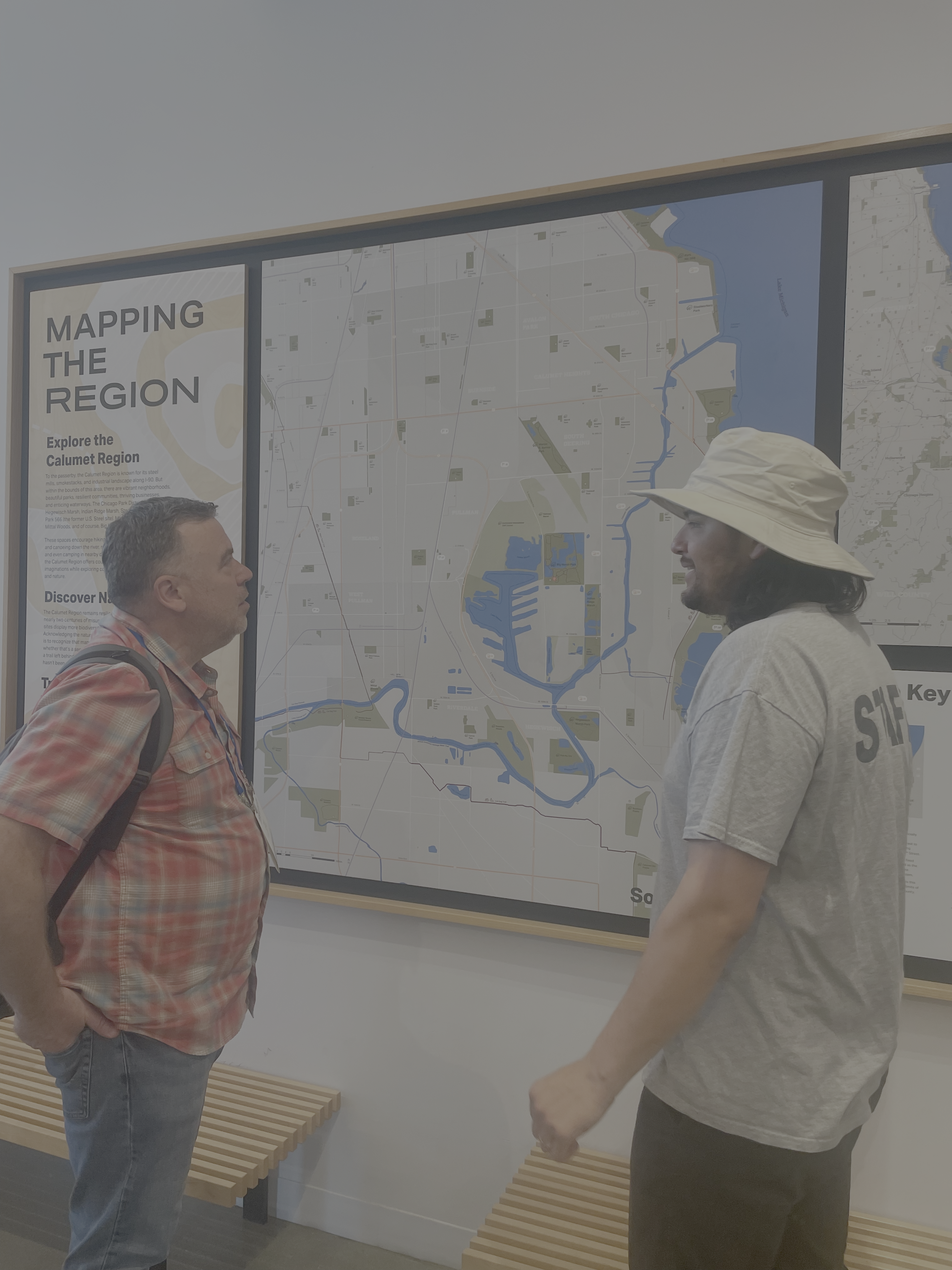 |
| Tour leader Brett Chase, left, with Luis Cabrales, program and event facilitator for Chicago Parks Department, at Big Marsh visitor center. Photo: Tina Deines. |
The tour continued through the 10th Ward Industrial Corridor, Chicago’s most polluted industrial area and home to three active Superfund sites, as well as abandoned steelmaking brownfields.
The bus also passed by rolling hills — of garbage. “Anytime you see a hill in Chicago, that was a landfill at some point,” Chase had explained earlier in the tour.
While in Chicago’s Hegewisch neighborhood, Ramirez, who grew up in the Southeast Side, spoke about the issues facing this Latino-majority area, including a neon-yellow sulfur pile that releases foul odors.
“Once you get close, it kind of tastes like sparklers,” she said. “You can taste it.”
The group also stopped at Big Marsh, a 299-acre park in the South Deering community. The city of Chicago-managed space, now home to wildlife habitat and 140 acres of bike park, sits on a historic wetland that once served as an industrial dumping ground for slag from steel mills in the late 1800s and early 1900s.
Hazel Johnson led a movement in the 1980s to fight against further industrial degradation and landfill expansion there, and the Chicago Park District purchased the land in 2011. After restoration activities, the space opened to the public in 2016.
At the park’s Ford Calumet Environmental Center, Luis Cabrales, the CPD’s program and event facilitator, characterized the space during a short presentation as a “postindustrial park,” and said it welcomes field trips, bird watchers, researchers and cyclists.
Cabrales also lamented the ongoing environmental hazards that surround the property. For instance, compost heaps are piled atop garbage-filled mounds at a landfill adjacent to the park. On warm, windy days, this compost — food waste from all over Chicago — heats up, sending smoke into the park and nearby neighborhood.
One of the tour attendees noted the paradox of one environmental solution leading to another environmental problem.
Inside the park center, tour attendees also got the chance to check out interpretive panels about local wildlife, environmental justice and recreation opportunities.
‘A cumulative burden’
Throughout the tour, Ramirez pointed out how close polluting industries often are to the community. For instance, a manganese facility sits next to a Little League field. In addition to contributing to local air quality issues, it has leached lead, arsenic and manganese — all toxic heavy metals — into the soil at the nearby baseball field.
Meanwhile, readings at George Washington High School, which serves students in Hegewisch and South Deering, have shown some of the worst air quality in the state, she said.
Ramirez also talked about the compounding impacts of other issues, such as lead pipes. Chicago has the most lead water service lines in the country, and the South Side is disproportionately affected.
“That adds to the cumulative burden,” she said, adding that the area is also a food desert and transportation desert.
Throughout the day, Ramirez pointed out greenwashing tactics used by polluting industries in the area, as well as the irony of natural spaces — marshes, Lake Michigan shorelines and parks — and environmental degradation coexisting in South Side communities.
“You have Little League fields, Superfund sites, and then you have a state park,” she said. “Every green space is dominated by industry.”
Tina Deines is an Albuquerque-based writer specializing in nature, the environment, wildlife and conservation. Her work has appeared in National Geographic News, Sierra, The Guardian, Pacific Standard, High Country News and Mongabay. Deines is also the author of the children’s book, “Daisy Sniffs Out Nature.” She previously worked as editor-in-chief and contributing writer for New Mexico Wild and the New Mexico Wild Guide.
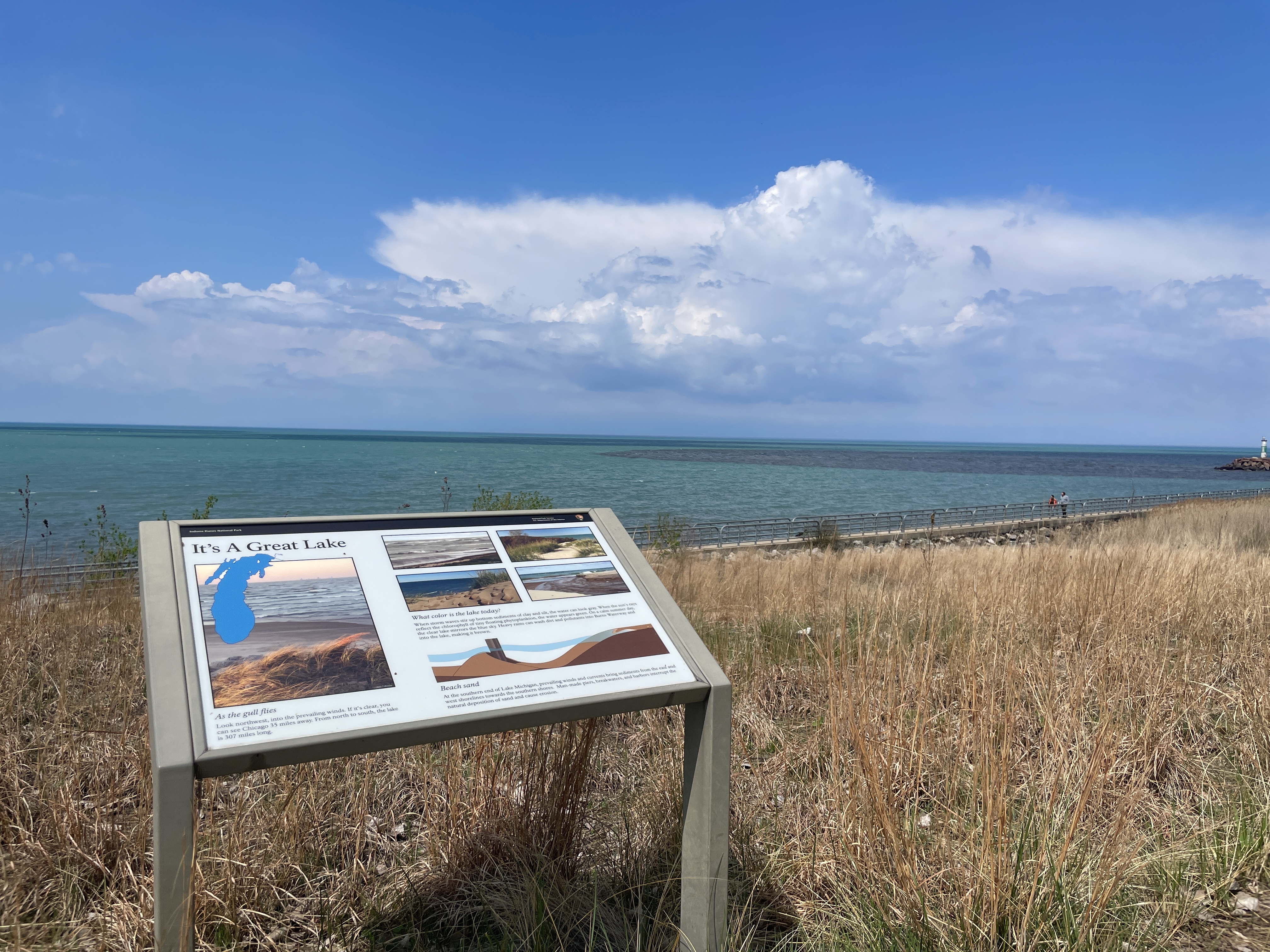 |
| Surrounded by industry, the Indiana Dunes National Park faces unique ecological challenges. Photo: Julie Zenderoudi. |
Industry, Budget Cuts Converge on Indiana Dunes’ Fragile Ecosystem
National park confronts mounting environmental threats as local communities work to sustain ecosystems
By Julie Zenderoudi
Bring your binoculars to Indiana Dunes National Park, and you might spot a great blue heron, an American woodcock — and a steel mill.
Located in northwestern Indiana, less than an hour from Chicago, the park is made up of converging ecosystems, from beaches and prairies to wetlands and savannas. What sets it apart from other national parks, however, is the industry that surrounds it.
Coal-fired power plants and industrial steel mills are embedded within the landscape, posing threats to the park’s delicate ecosystem.
“We have this juxtaposition of two things that really shouldn’t be together, but they are,” says Paul Labovitz, the park’s former superintendent, who retired in 2023.
A collision of ecosystems, the Indiana Dunes has unique challenges that the conservationists are working to address.
“Most people, when they think of national parks, don't often think about the infrastructure and the industry that is surrounding these areas. They think of these wild, untouched places,” says Trevor Edmonson, Northern Indiana stewardship lead at the nonprofit Nature Conservancy.
Vulnerability to invasive species
Because the dunes are an edge habitat — when one ecosystem meets another — invasive species are another threat to these native areas.
A 2024 case study by the National Parks Conservation Association found that air pollution stemming from coal-fired power plants and steel mills left the park particularly vulnerable to invasive species. Excess pollutants in an ecosystem can lead to overgrowth of harmful organisms; for instance, causing invasive plants to spread and risk reducing the natural biodiversity.
In another example, the emerald ash borer, a nonnative beetle that can tolerate polluted environments better than native species, has rapidly spread throughout the park. As a result, the native ash tree population has suffered.
Prescribed fires are one way conservationists are addressing the invasive species issue. “Almost all of our burns here are controlled,” says Edmonson. “It’s a vital part of this ecosystem recovery,” he explains. They happen frequently, with eight prescribed fires scheduled this spring.
According to the National Park Service, prescribed fire at Indiana Dunes is an essential element in the park’s long-term natural resources restoration goals, helping to remove invasive species, open tree canopies and increase wildlife habitat.
Learning from the original stewards
 |
| The Indigenous Cultural Trail at the Indiana Dunes National Park features limestone snapping turtle sculptures with Indigenous calendars on their shells. Photo: Julie Zenderoudi. |
As Edmonson and his team work to restore the Dunes, he acknowledges there is much to learn from Indigenous peoples, the original stewards of the land.
Indigenous knowledge and stewardship is being recognized with the creation of the Indiana Dunes Indigenous Cultural Trail, which aims to feature and honor the Miami and Potawatomi Indigenous peoples.
The trail includes a firepit adorned with Miami designs, and limestone turtles designed by a Potawatomi artist, among other trail elements. The trail is a collaboration between Indiana Dunes Tourism, Indiana Dunes National Park, and the Miami and Potawatomi tribes.
Bmejwen Kyle Malott, advanced language specialist with the Pokagon Band of Potawatomi, hopes that visitors will broaden their understanding of the Potawatomi culture as they visit the trail. “We are the original people of this land here, and we are still living here where we originated,” he says.
The trail is meant not just to reflect the past, but the present and future of Potawatomi and Miami culture. “It’s in order to pay respect to all of our ancestors and the ones that are to come,” he says. “Because some of our responsibilities is to take care of what’s here, so we take care of it in order that our children and our grandchildren can have these things too,” he added.
Malott is hopeful other national parks can follow what’s been accomplished at Indiana Dunes. “I think any park or national park should work in collaboration with the local tribes of that land.”
Along with various interactive design elements, there are also efforts to plant and protect native plants, such as manoomin, a variety of wild rice.
“We work with one of the plants that is very directly tied to the Potawatomi peoples and Indigenous cultures, manoomin,” explains Jennifer Kanine, director of the Department of Natural Resources for the Pokagon Band of Potawatomi.
She and staff at the park harvest small amounts of the wild rice to reseed and strengthen existing beds, and treat invasive species that are directly adjacent to manoomin.
Park budget cuts, community action
Under the current administration, national parks have experienced significant budget cuts and staffing shortages. In fact, the Trump administration’s latest budget proposal aims to make a $736 million reduction to park operations, which will likely affect staffing.
Labovitz says that the loss of temporary workers and seasonal employees has added an immense strain on full-time employees. “They’re beat to death,” he says. “Every day is brutal,” adding that the park is doing much less public programming due to the lack of resources.
Meanwhile, residents of the community surrounding the park, who have long faced the negative health effects of pollution from nearby steel mills, are taking action to protect their environment.
Just Transition Northwest Indiana, a grassroots environmental justice organization, advocates moving away from coal-based steelmaking to greener alternatives.
“Most of the people I know have asthma; we all have inhalers,” says Lisa Vallee, organizing director, while adding, “We have the workforce, the facilities, the lake; we have everything we need to make green steel."
Julie Zenderoudi is a Canadian journalist based in Brooklyn, New York. She’s currently completing her master's degree at New York University in the science, health and environmental reporting program. She writes about the environmental impacts of fast fashion, and the intersection of climate and health.
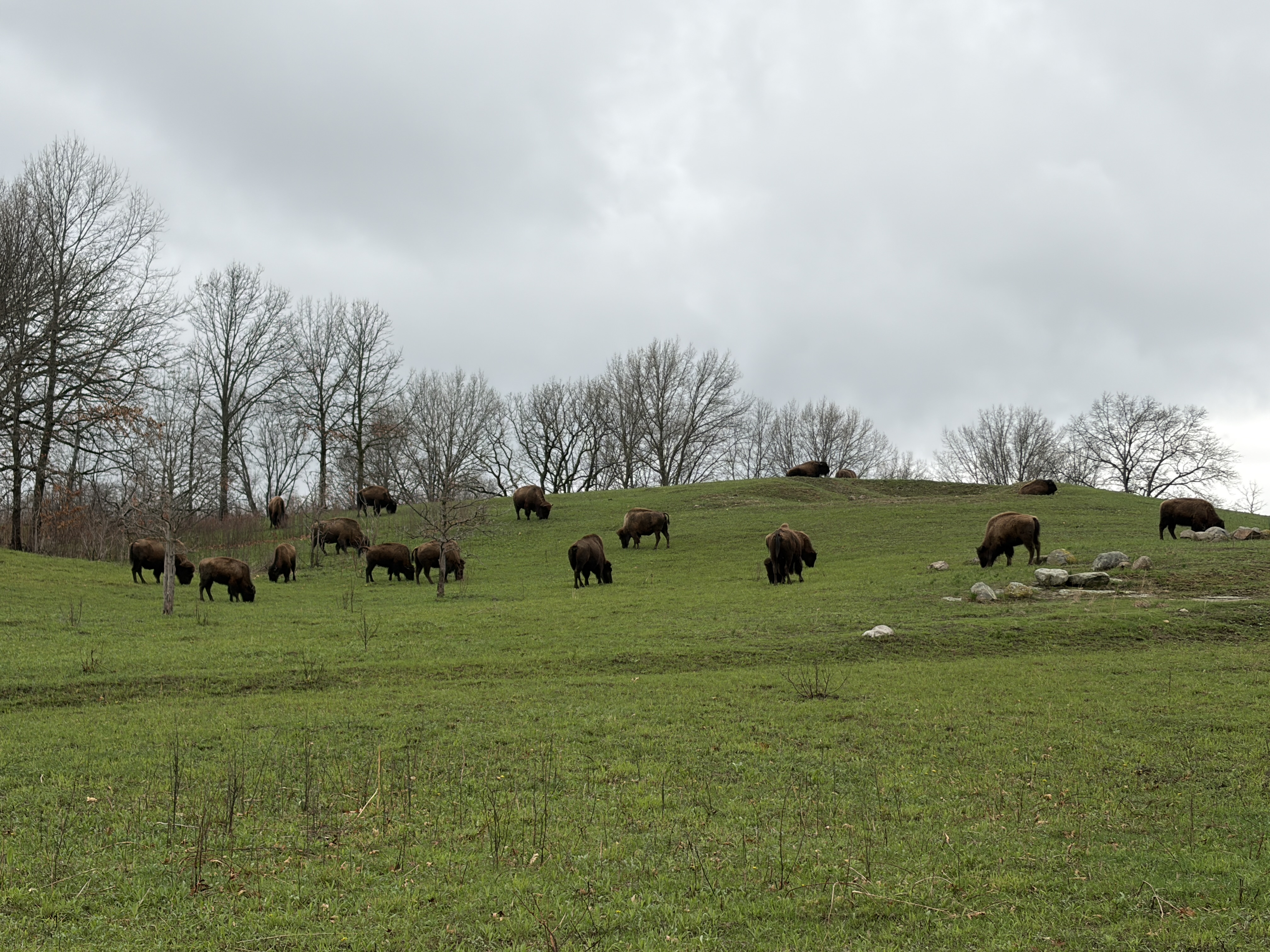 |
| Buffalo have reshaped the physical landscape of Nachusa Grasslands through their foraging and social behaviors. Photo: Madeline Shaw. |
Fire, Seeds and Grazing Hold the Key to Prairie Restoration at Nachusa Grasslands
Over 40 years, reintroduced native plants and buffalo have helped turn old agricultural land into a biodiverse ecosystem
By Madeline Shaw
One hundred miles west of Chicago, the rolling hills of Nachusa Grasslands offer a rare glimpse into one of the world’s most endangered ecosystems: the tallgrass prairie. Despite once blanketing the state, only one-tenth of 1% of Illinois’ prairie remains, the rest lost to agriculture and development.
Even the land that is now Nachusa was once home to rows of cornstalks and herds of cows, back when The Nature Conservancy purchased the first tract 40 years ago.
But prairie remnants lingered in the rocky hilltops and wetlands that farmers had avoided, holding the literal and figurative seeds that would eventually help restore more than 4,100 acres of this diverse ecosystem.
Restoration work often involves reintroducing natural forces that disappeared from the landscape. “Prairies evolved through disturbance — fire, flooding, grazing — and it really was never a stagnant ecosystem,” said Tyler Pellegrini, a restoration ecologist at Nachusa Grasslands. “Things were always changing.”
Rediscovering the benefits of burning
Fire is especially important to rewilding Nachusa.
A team of restoration ecologists and volunteers conducts controlled burns every year in the spring and fall on a rotating schedule, with sections burned every one to three years.
The fires slow the spread of invasive species, recycle nutrients back into the soil and allow more sunlight to reach sprouting native plants.
“The prairies just love that fire,” said Bill Kleiman, project director for the Nachusa Grasslands.
Indigenous Americans had long used fire as a land management practice, but conservationists only recognized its ecological benefits for species health and diversity more recently.
“We were missing the element of prescribed fire, which is what the Native people were doing all along,” said Kleiman, who is the statewide fire manager and has conducted more than 500 burns over his career.
Rockstars of the prairies
On a spring day in April, last fall’s fires were already yielding new growth. Green shoots standing just a few inches tall peeked out among the charred stems. The emerging native plants offer a tasty snack for grazing buffalo — also known as bison — the other key force shaping the prairie ecosystem.
First introduced to Nachusa in 2014, the buffalo herd is now 100 strong (and due to increase with the imminent arrival of this year’s calves).
Over more than a decade, they have left a noticeable mark on the prairie. They create large, shallow dirt pits in the grass — known as wallows — that provide insect habitats and collect rainwater.
Their fur also acts as insulation for birds’ nests, and their waste recycles nutrients that support future plant growth. Even their movements shape the landscape, aerating the soil and creating patches in grazed vegetation.
“Bison have been shown to be that ecological keystone, supporting habitat for many species,” said Cody Considine, deputy director for Nachusa.
But while they might be “the rockstars of the prairies,” he noted, “they are part of the whole” and no more important than the birds and grasses and other mammals that call the preserve home.
The herd is actively managed by Nachusa’s staff and is monitored by a veterinarian. When it becomes too large for the preserve to maintain, Nachusa sends its excess buffalo to Native American tribes looking to build their herds through the InterTribal Buffalo Council.
Prairie lab, seedbank, work of art
With so much restoration and conservation work underway, Nachusa essentially functions as a prairie laboratory.
At least 100 peer-reviewed papers have been published about the preserve, and it is home to a full-time ecosystem restoration scientist, Elizabeth Bach, who is studying the impact of restoration work on the plants, animals and soil of Nachusa.
The preserve is now home to 245 bird species, more than 700 native plants and unique animals like the ornate box turtle.
Overall, rewilding the prairie is hard, unrelenting work.
In addition to managing fires and buffalo herds, the staff and volunteers pick thousands of pounds of seeds every year from May through the end of October. Some smell like sweet hay, others like sweaty socks, but all of them are dried, processed, mixed and stored in paper barrels in the seed barn.
Some of the seeds will be sent to other prairie restoration projects, but with 50 to 60 pounds of seed needed per acre, most will be spread at Nachusa on individual plots adopted by volunteers.
The dedication of Nachusa’s volunteers is “like a beautiful work of art that people are doing collectively,” said SEJ board member and author Madeline Ostrander. “It’s this representation of the relationship we could be having with nature that we very seldom get to have.”
“It was like a love letter to the prairie,” Michelle Kanaar, visual editor at CatchLight, said of her visit to Nachusa. “It’s hopeful.”
Madeline Shaw is a freelance journalist and master’s student in NYU’s science, health and environmental reporting program. She covers biodiversity and conservation issues.
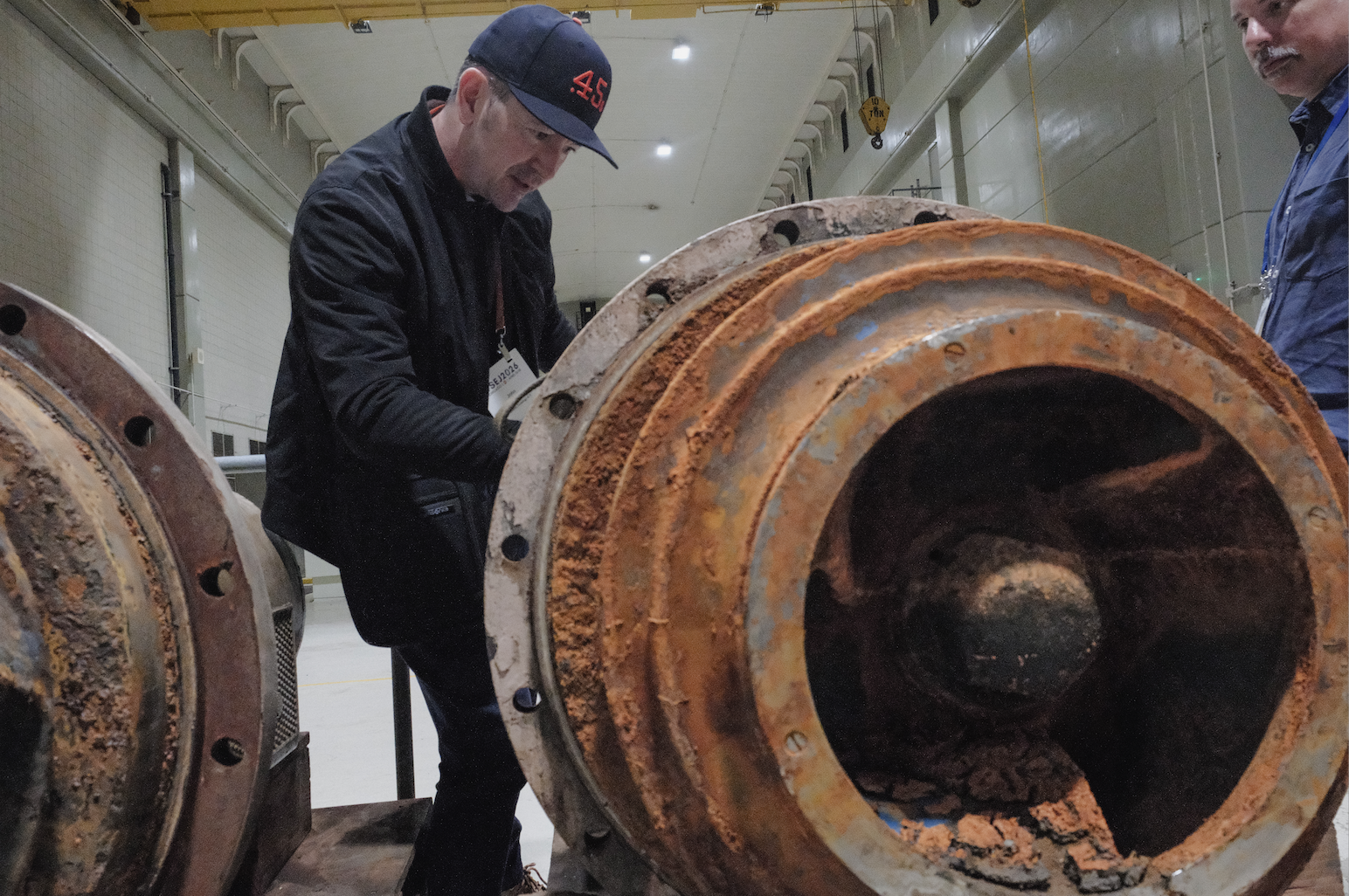 |
| Tour participant John Mone inspects a piece of equipment at Chicago’s Metropolitan Water Reclamation District. Photo: Emma Schneck. |
After Record-Breaking Rains, Chicago’s Wastewater Managers Struggle To Serve Local Residents
Increasingly intense storms stress aging water-management infrastructure and fill new reservoirs to overflowing
By Emma Schneck
On April 15, Princess Shaw received over 15 calls in the middle of the night from folks who reported that their basements were flooded due to the recent storm.
Such calls are a regular occurrence for Shaw, whose work as a community advocate and founder of Light Up Lawndale has connected her to many individuals experiencing flooding across the South Side of Chicago.
While last week’s record-breaking rainfall caused flooding all over the city, these incidents have become increasingly frequent over the past decade, said Shaw. The flooding events occur when excess stormwater overwhelms the city’s infrastructure and forces water into the streets and riverways.
As a part of the #SEJ2026 conference, a group of journalists toured several sites around Chicago to understand the reality of the city’s wastewater situation.
Billions of gallons
The tour included various locations managed by the Metropolitan Water Reclamation District of Greater Chicago, the government agency that oversees wastewater treatment and stormwater management for Cook County, Illinois.
Notably, the MWRD manages the wastewater reclamation point in Stickney, Illinois, which is one of the largest wastewater plants in the world.
According to Mike Hill, chief operating engineer of MWRD, the agency created the Tunnel and Reservoir Plan in the 1970s as a way to manage Chicago’s flooding problem. As municipal sewers were often overwhelmed with stormwater, the MWRD dug a series of tunnels, intercepting sewers and backup reservoirs to hold excess water.
“After large storm events, we store stormwater in these large reservoirs until we are able to treat it,” said Hill.
If the reservoirs reach capacity, any additional wastewater is diluted and then diverted into Chicago’s waterways.
Despite being one of the largest wastewater treatment facilities in the world, the system will overfill if the city receives too much rainfall within any given time.
The largest TARP containment unit, the McCook Reservoir, can hold up to 3.5 billion gallons of wastewater at a time.
But when the tour participants visited this reservoir, it was already at full capacity, with additional rainfall predicted for the coming week.
Since the McCook Reservoir went online in 2017, the system has overfilled nine times, said MWRD engineer Anthony Zogas.
And as Chicago experiences more record-breaking rainfalls, Zogas attests that these overfill instances are happening with increasing frequency.
Rain barrels or bigger pipes?
When asked about MWRD’s long-term plans to adapt to increasing rainwater entering the city’s infrastructure, Zogas pointed to one potential solution: rain barrels.
He said that having individual residents collect their own stormwater in barrels can help keep it out of the system and prevent overfill. The MWRD website encourages residents to use this water for a variety of household uses, such as watering plants.
However, to Light Up Lawndale’s Shaw and other community activists, this kind of initiative does not address the root cause of Chicago’s flooding problem: aging infrastructure that has not been adapted for Chicago’s modern needs.
As Shaw sees it, Chicago’s flooding problem “is a structural issue, not an individual one. We have to make these systems work for us today.”
Cyatharine Alias, a director at the Center for Neighborhood Technology, shares a similar outlook on Chicago’s wastewater infrastructure. “We need bigger pipes, and we need better water storage,” she explained.
Beyond fixing Chicago’s wastewater physical infrastructure, Shaw would like to see city and government officials working directly with communities affected by flooding. “We need better collaboration across agencies and with communities,” she said. “The city of Chicago needs to acknowledge the harm that has happened.”
These discussions resonated with tour participant John Mone, a press officer with the Danish-based organization Grundfos. In his opinion, the tour highlighted a need for better collaboration between city officials and community organizers.
“A lot of what we witnessed today is the direct consequence of aging infrastructure and water-stressed systems that have worsened due to climate change,” Mone said. “Last I checked, clean drinking water is a pretty bipartisan issue.”
Emma Schneck is a New York-based environmental journalist originally from Hawai’i. She holds a master’s degree in nature, society and environmental governance from the University of Oxford. She currently runs a newsletter on the environmental impacts of tourism and travel.
View a slideshow of tour photos below.

* From the weekly news magazine SEJournal Online, Vol. 11, No. 16 and 17. Content from each new issue of SEJournal Online is available to the public via the SEJournal Online main page. Subscribe to the e-newsletter here. And see past issues of the SEJournal archived here.
SEJ Publication Types:
Topics on the Beat:
Visibility: