


SEJournal Online is the digital news magazine of the Society of Environmental Journalists. Learn more about SEJournal Online, including submission, subscription and advertising information.
August 5, 2026
 |
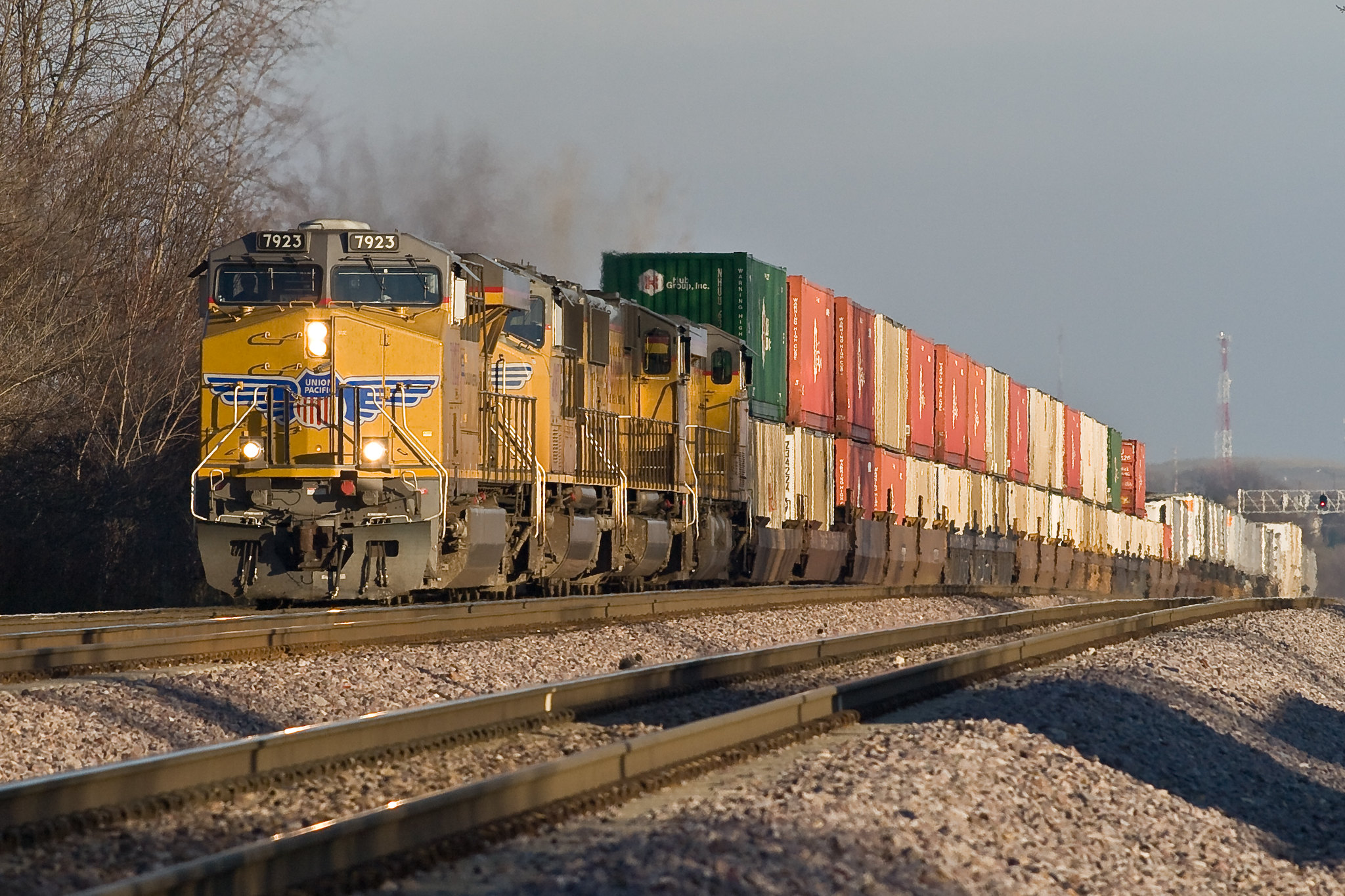 |
| A freight train rolls through LaFox, Illinois, a historic railroad town about 40 miles west of Chicago. Photo: Ron Zack via Flickr Creative Commons (CC BY-NC-SA 2.0). |
Feature: Taming the Freight Beast
By John Lippert
With the Iran war having driven diesel and gas prices to record highs, America’s freight system is facing unprecedented strains and cascading effects that highlight the urgent need for cleaner, more efficient alternatives.
At the same time, rollbacks of federal regulations under the second Trump administration are putting the brakes on efforts to curb freight-related pollution.
But although the federal obstacles are daunting, zero-carbon transportation experts from the public, private and nonprofit sectors say state and local leaders still have practical tools to advance clean freight.
Here’s what’s happening in two key states: Illinois (home to America’s largest rail and road hubs) and California (home to the nation’s largest seaports).
The Clean Air Act and beyond
Chicago is the country’s central train and truck crossroads. According to the Swiss technology company IQAir, it has the third-highest PM2.5 concentration (may require subscription) among major U.S. cities. These tiny airborne particles can settle deep inside human lungs and contribute to premature births, asthma and dementia.
Despite Trump’s regulatory U-turns,
the U.S. Environmental Protection
Agency still classifies PM2.5 as
a threat to human health.
Despite President Donald Trump’s regulatory U-turns, the U.S. Environmental Protection Agency still classifies PM2.5 as a threat to human health. And the 1970 Clean Air Act still requires the United States to fight such pollutants wherever scientists find them, according to Liane Randolph, chair of the California Air Resources Board for five years ending in 2025.
“It’s really important not to be too defeatist,” Randolph said, referring to the Clean Air Act, “because the basic pieces are still there.”
“If there is an administration change beginning in 2029, it will be possible to undo some of the damage,” she added.
But she doesn’t sugarcoat what’s happening.
Randolph noted that Congress passed former President Joe Biden’s big clean air and infrastructure bills by razor-thin margins. And she recalled her dismay when corporate leaders rallied around Trump’s return.
“Toyota is one of the worst companies when it comes to advocating against clean air progress,” she said, referring to the Japanese automaker, which enjoyed an immense environmental halo after it introduced the first mass-produced gas-electric hybrid, the Prius, in 1997.
Other companies that had embraced California’s clean air goals, including Volvo Trucks, were happy to jump on the Trump bandwagon, she added.
Nonetheless, even as California spars with Trump on multiple legal fronts, the state has plenty of tools for cleaning up its own air, Randolph said.
These include the low-carbon fuel standard, which regulates electricity as a fuel and funds subsidies that have helped place 11,600 low- and zero-emission cargo trucks on the state’s highways.
New rules for warehouses
California may also expand its indirect source rule statewide.
First adopted in Los Angeles in 2021, this rule makes warehouses responsible for pollution from both their own operations and the diesel trucks they attract.
Some Californians have raised affordability concerns about the proposed expansion, Randolph said. There are also complaints that the benefits wouldn’t be shared equally, since some areas of the state are less polluted than others.
In Illinois, an indirect source rule
like California’s recently failed to
gain enough legislative votes
to advance out of committee.
In Illinois, an indirect source rule like California’s recently failed to gain enough legislative votes to advance out of committee. Still, groups such as the Environmental Defense Fund and Chicago’s Respiratory Health Association plan to keep pushing.
James Jennings, director of the Illinois Environmental Protection Agency, also described warehouses as a threat to air quality.
“You can drive into Chicago from any direction and warehouses and data centers are popping up,” Jennings said. “These are going to have really profound stationary and mobile impacts,” he said, referring to how the state classifies different air pollution sources. “We have to make sure we’re not further creating a problematic situation for people who live there.”
For example, Jennings said, the Illinois EPA is using its existing permitting authority to keep a lid on contaminants like PM2.5 and ozone as warehouses and data centers seek to expand in already-polluted urban areas like Chicago and East St. Louis.
How to keep electric trucks rolling
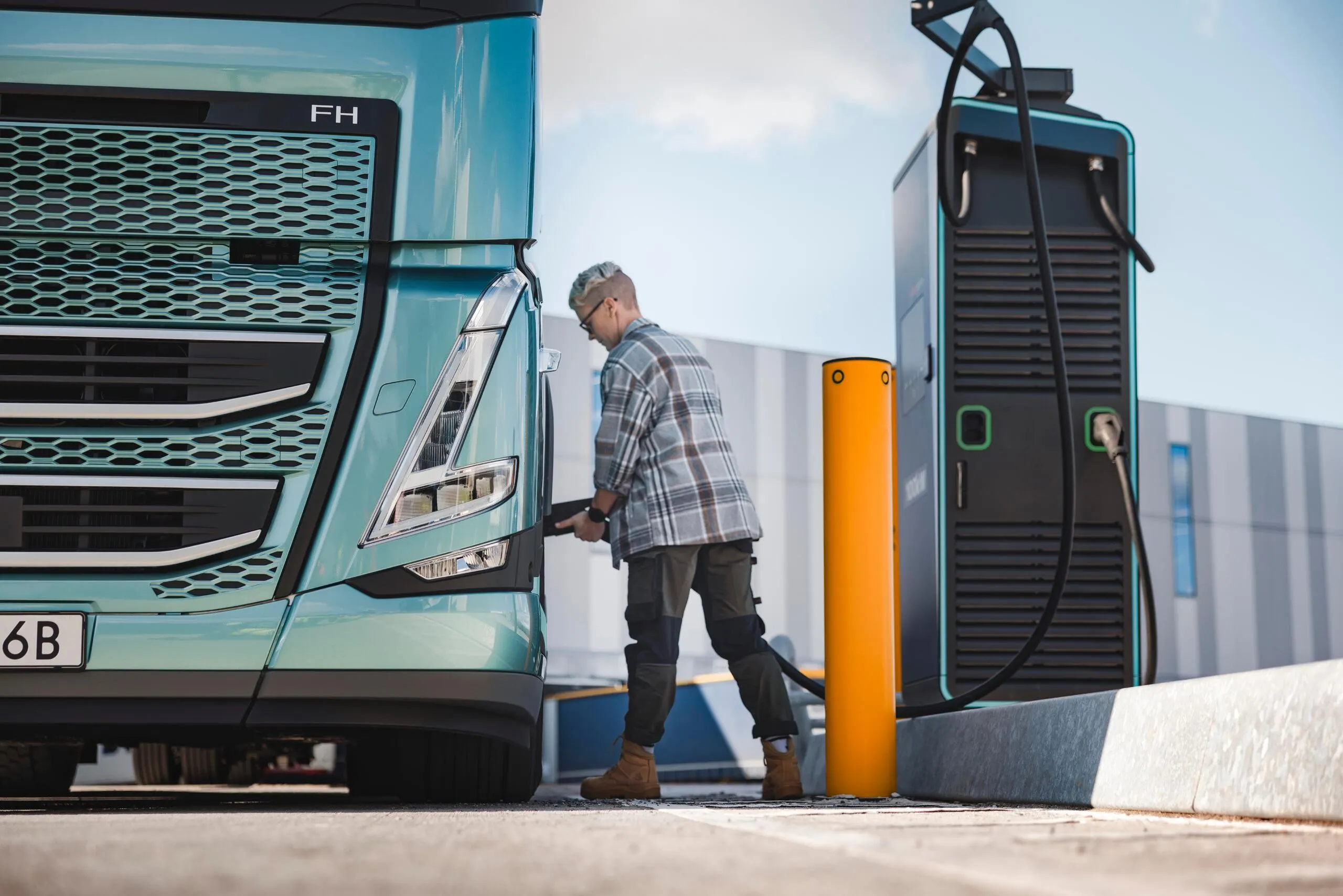 |
| A driver charges an electric freight truck in Europe. Photo: Volvo Group. |
Jennings cited Trump’s federal PR megaphone as a key challenge to making U.S. freight systems cleaner.
In December, Illinois and 15 other states sued the Trump administration over its attempt to block Biden’s fast-charging network funds for electric trucks. A judge sided with the states, forcing federal officials to release $148 million for chargers in Illinois.
“We are, as states, in this incredibly difficult position of having to divert time, energy and resources away from running programs, and instead, having to push back on some of these federal proclamations,” Jennings said.
In the United States, electric vehicle sales are running at about half (may require subscription) the level they were at last year, before Trump eliminated consumer rebates.
But the picture is not all bleak, according to Nate Baguio, a strategic adviser for TCCI, a Decatur, Illinois-based company that makes electric air compressors. These critical components help batteries and motors inside electric vehicles breathe, allowing them to regulate their internal temperatures. And TCCI builds the compressors in Argentina, India and China, not just in Decatur.
EV sales in Europe are still rising, and India plans to replace 800,000 diesel buses with battery-powered models by 2031. Baguio is also eyeing completely new markets, and says data centers might be good fits for TCCI compressors.
“A lot of people are repeating, ‘We need certainty from government.’ But we assume regulatory volatility,” Baguio said. “We don’t build business plans on incentive programs that might be short-lived.”
Even in relation to China’s overwhelming lead in electric vehicles, batteries, solar panels and wind turbines, Baguio is surprisingly bullish.
“I think we lead in systems, software design, a lot of things,” Baguio said of U.S. manufacturers. “Just down the road from our factory in Decatur is the University of Illinois, which trains 20,000 engineers a year. That’s more than MIT, Stanford, a lot of universities combined.”
“When you look at the vehicles China is building, they have a shelf life of five years, where we’re still designing and building something like your Maytag washer, that’s going to last for 30 years,” Baguio said.
Fine-tuning the message
Trisha DelloIacono is head of policy at CalStart, a Pasadena, California-based nonprofit that’s been promoting clean transportation since 1992.
She said Biden did a good job of hosting regular White House roundtables, in which CalStart participated, for freight, shipping and rail executives to discuss policy options.
Just six months before he left office, Biden’s EPA announced a $249 million grant to build electric truck charging stations along the I-95 corridor in Connecticut, New Jersey, Delaware and Maryland.
But now, CalStart needs to function in Trump’s Washington.
“One of the things we’re trying to do at CalStart is lower the temperature on electric vehicles,” DelloIacono said.
“We’re trying to make sure there’s an economic case. And that you’re not just doing it because it’s better for the environment, better for the climate and good for public health. Those are all really important messages, but not messages that are going to resonate with this administration,” she said.
“Instead, what we’re showing is that this is a business,” DelloIacono said. “It provides a workforce, it provides economic stability and it provides global competitiveness. These are messages we’re trying to repeat over and over.”
[Editor’s Note: Material for this story was drawn from a panel moderated by Lippert at the Society of Environmental Journalists’ annual conference in Chicago, in April 2026, whose sponsors are listed here.]
John Lippert has been a freelance writer for the Chicago Tribune since 2022. Before that, he worked for 22 years as a bureau chief and senior writer at Bloomberg News. He’d previously been the Detroit Free Press labor writer. Early in his working life, he spent eight years on the assembly line building cars for General Motors.
* From the weekly news magazine SEJournal Online, Vol. 11, No. 28. Content from each new issue of SEJournal Online is available to the public via the SEJournal Online main page. Subscribe to the e-newsletter here. And see past issues of the SEJournal archived here.
SEJ Publication Types:
Topics on the Beat:
Visibility: