


SEJournal Online is the digital news magazine of the Society of Environmental Journalists. Learn more about SEJournal Online, including submission, subscription and advertising information.
June 24, 2026
 |
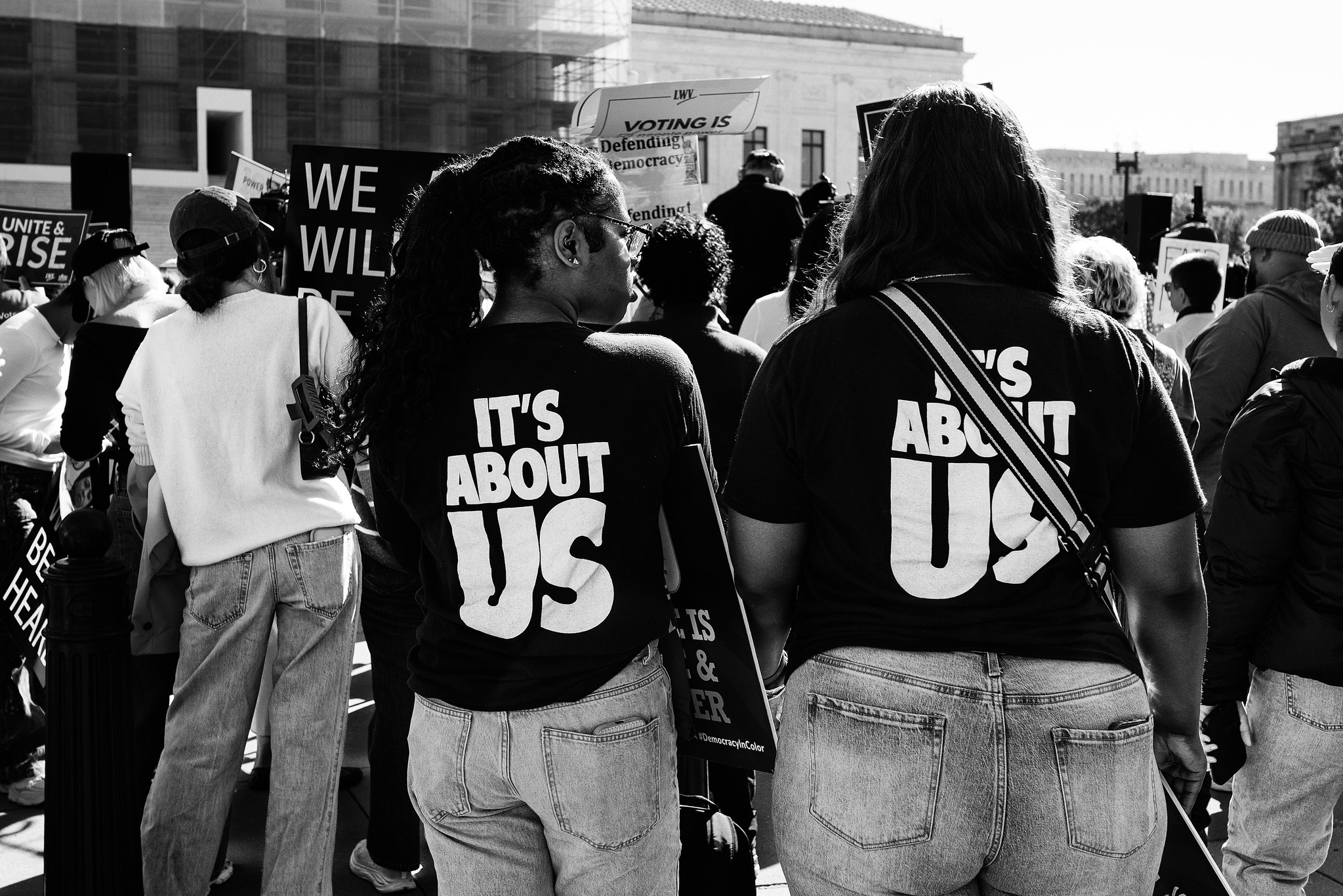 |
| A voting rights rally at the Supreme Court in October 2025, ahead of the Louisiana v. Callais ruling that stripped additional powers from the Voting Rights Act. Photo: Miki Jourdan via Flickr Creative Commons (CC BY-NC-ND 4.0). |
Voices of Environmental Justice: Why the Loss of Voting Rights Is a Climate Crisis
By Yessenia Funes
Few voices connect the dots between democracy, voting and climate change the way Bill McKibben does.
Indeed, his writing is the only one in recent months I could find that dared to talk about the planet’s rising temperatures alongside society’s worsening decline into authoritarianism.
Without universal voting access, authoritarianism is, indeed, where we’re headed. And if the people don’t have a say, who’s going to protect them from the summer’s extreme heat or supercharged hurricanes?
‘At this point, the climate dilemma
in America is largely a fact of
our political dysfunction.’
— Bill McKibben
“At this point, the climate dilemma in America is largely a fact of our political dysfunction,” wrote McKibben in an email to me.
“Since we let the rich spend big to dominate our politics,” he explained, “the cash flow of Big Oil means they have hugely outsized influence, even as the need for them disappears. They spent half a billion electing the GOP last cycle, and their return on investment will be truly enormous, while the rest of us pay high prices for energy and watch the planet get ever hotter.”
While many of us climate reporters know McKibben for his advocacy, his career began much like ours — in journalism. He led The Harvard Crimson before graduating and securing a staff writing gig at The New Yorker. He covered environmental issues before the terrifying urgency of today.
No one listened. Let’s be real: World leaders still aren’t. So he took his work a step further. In 2021, he founded Third Act, a climate organization for older people who want to offer their wisdom to the movement. The group focused on climate and democracy on purpose. “They seem so interrelated to me,” McKibben said.
Voting rights is an environment story, too
This connection has become especially pronounced in the wake of the Supreme Court’s April decision in Louisiana v. Callais to strip down Section 2 of the Voting Rights Act.
The Voting Rights Act was a seminal piece of U.S. legislation, codifying protections for Black Americans who faced poll taxes and literacy tests when they tried to vote in southern states after the Civil War.
These racist practices became illegal with the law’s passing in 1965, but the latest Supreme Court decision is allowing states to redraw voter maps on the basis of political party, regardless of the outcomes that will have on Black representation at the polls.
Climate desks (the few that remain, at least) have been largely quiet on the matter, but this decision is not only a story about civil rights and racial justice — it’s an environmental and health story, too.
Representatives accountable to the community
Leslie Fields has a background in civil rights and voting rights work. She worked at the NAACP, where she discovered environmental justice as a focus in Texas. Now, she is the chief federal officer of the Harlem-based environmental justice advocacy group WE ACT.
WE ACT has been responding to the nationwide consequences of the Voting Rights Act’s rollback. Section 2, in particular, is about voters electing the representatives they want. It’s about the people choosing the person they trust to lead.
“If we don’t have the representatives we need, who come from the community and are accountable to the community, then you’re going to have terrible decisions being made on the local level and all the way up regarding the environment, regarding communities’ sustainability, regarding where investments are being made,” Fields said.
“Some of the states that we’ve lost billions of dollars in Justice40 funds from the Biden administration to support climate resilience and adaptation,” she added, “won’t have the leadership to represent them, and we’re still fighting to get that funding back.”
She points to the wider Environmental Justice Leadership Forum on Climate Change, which WE ACT coordinates. Fields said the coalition anticipates that at least 10 member organizations will be directly affected by these new redistricting maps in states such as Texas, Tennessee and Florida.
‘Organizations in former Confederate states
have had a very tough time already
getting enforcement for legacy
environmental justice issues.’
— Leslie Fields, WE ACT
“Organizations in former Confederate states have had a very tough time already getting enforcement for legacy environmental justice issues,” she said. “The enforcement is simply not there on the federal, state and local levels. We’re seeing this, in particular, with the rise of the data centers.”
The people need to vote into office individuals who stand with them and their desires for their community. If they don’t support the construction of a new data center or gas plant, neither should their elected officials. With this loss, voting districts may not accurately represent the people who actually live there, silencing their voices and threatening their well-being.
“It’s really terrible that, within my lifetime, the Voting Rights Act is being gutted so, and that we’re sliding back to pre-1965,” Fields said.
When I asked Fields how journalists on the beat can connect this issue to their work, she suggested we focus on public health. Whether reporters are covering extreme heat or energy costs, policy — and the people who write, pass or block bills — helps determine the types of protections local community members receive.
“It’s super important that they have representation that reflects the needs of that local community,” Fields said. “Not someone who is backed by some big corporate funder or someone who’s got another agenda.”
‘Climate-and-energy warrior’ a target of redistricting
One of the first states to take advantage of the court ruling to redraw its maps was Tennessee. The state’s two majority-Black districts were lost as a result.
“The entire effort was aimed at making sure Justin Pearson wouldn't have a House seat,” McKibben said. For those who don’t know Pearson, he serves in the state’s House of Representatives and is running for Congress this year.
He’s a politician now, but he got his start as an environmental advocate fighting (and beating!) the Byhalia oil pipeline in 2021. McKibben described Pearson as a “true climate-and-energy warrior.”
These days, a big part of Pearson’s work revolves around a data center Elon Musk has built (subscription required) in Memphis — a facility the official opposes. He is still running despite his low odds for victory.
“Instead of his passion in Congress,” McKibben said of Pearson, “we'll now have some MAGA clone burbling on about CO2 as plant food.”
Black voters more concerned about climate
Black legislators (and Black voters) are key to climate policy, explained Saad Amer, founder of Justice Environment, a consultancy firm dedicated to the intersection of democracy and climate change.
“There is no voter in America who understands the importance of democracy and civil rights more than the Black voter,” he said.
A 2023 study found that this group is more concerned about climate change and more likely to take action than the national average.
On the legislative side, the Congressional Black Caucus has historically led legislative strides on issues relating to health, environmental pollution, and disaster recovery and response.
‘It’s not dramatic to say
that they’re trying to
reinstitute the Jim Crow era.’
— Saad Amer,
Justice Environment
“It’s not dramatic to say that they’re trying to reinstitute the Jim Crow era,” Amer said. “This all-out assault on Black political power in Congress, in particular, will then result in more members of Congress being elected who don’t believe in civil rights.”
As lawmakers strip away people’s civic power, communities may also lose the ability to legally organize, leading to further oppression as First Amendment protections diminish, Amer said.
This constitutional right remains an urgent one as the people in charge continue to unleash immigration agents onto communities or surveil activists, keeping individuals too fearful to leave their homes and engage in local issues.
“If we lose that ability of civic participation and organizing, then, of course, we won’t be able to address the climate crisis,” Amer said. “The same fight that a lot of reporters are feeling actively against the First Amendment and their own safety is the same one for civic participation and democracy.”
Diluted voting power damages community resilience
In order for communities to be free of polluters and safe from extreme weather, they need people in office who are accountable to them, not campaign donors. They need to elect officials who promise to do just that.
That becomes more challenging as states split communities into smaller groups, diluting their voting power and erasing the issues that matter.
As climate and environmental reporters, we have to look at the development projects we cover holistically. What are the politics of the state where a facility is being proposed or built? Does the local community want it? Are leaders listening to them? Why or why not? Does a campaign donation or gerrymandering scheme have anything to do with it?
That’s part of the story, too. Always.
Here are some resources for those curious about learning more about this intersection:
- Bill McKibben wrote a deep dive on the Tennessee battle between Pearson and Musk. Read the article from The New Yorker (subscription required).
- WE ACT has collaborated with the Natural Resources Defense Council to build a map of the communities that have lost federal funding. This can be a good place to investigate local election connections to see if there’s something more to the story.
- The Sierra Club also issued a statement after the Supreme Court ruling in April for those interested. The organization never responded to my request for an interview.
- I didn’t explore this connection in the column, but a Washington University paper published in February suggests that extreme weather events also impact voter turnout — another important parallel between the two issues.
Yessenia Funes is an environmental journalist who has covered the justice beat for a decade. She publishes a creative climate newsletter called Possibilities. Funes has written for publications like Atmos, Vogue, Vox, New York magazine, The Guardian and more. Her approach to storytelling amplifies the voices of those on the front line of our present-day ecological crises. Her reporting has taken her to the West Bank, remote Indigenous communities in Nicaragua, the hostile desert of the American Southwest and post-Hurricane Maria Puerto Rico.
* From the weekly news magazine SEJournal Online, Vol. 11, No. 25. Content from each new issue of SEJournal Online is available to the public via the SEJournal Online main page. Subscribe to the e-newsletter here. And see past issues of the SEJournal archived here.
SEJ Publication Types:
Topics on the Beat:
Visibility: