


SEJournal Online is the digital news magazine of the Society of Environmental Journalists. Learn more about SEJournal Online, including submission, subscription and advertising information.
April 22, 2026
 |
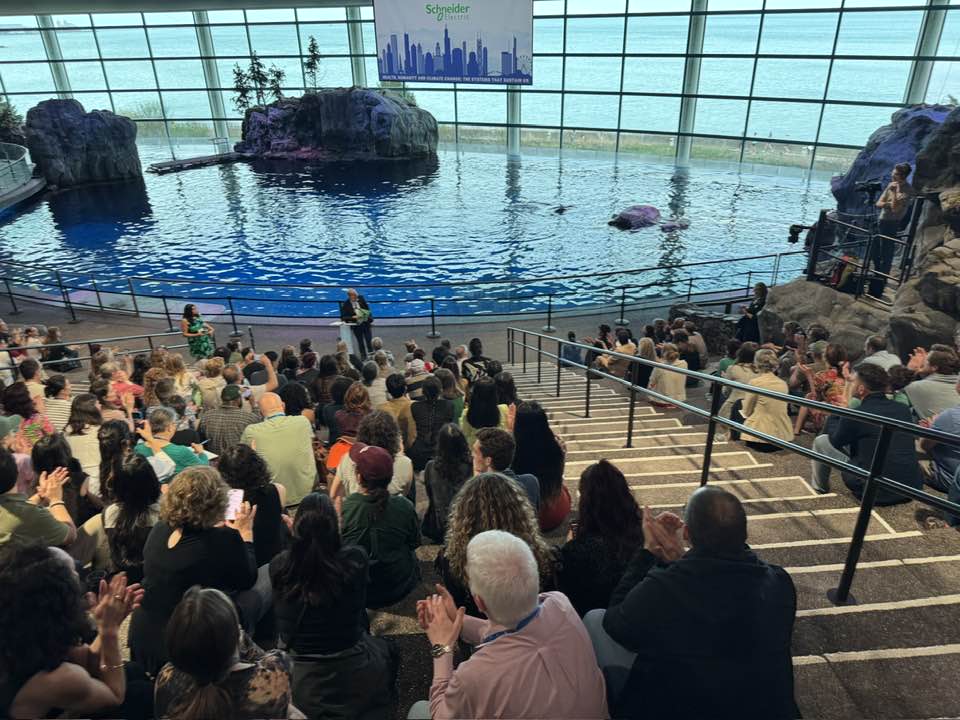 |
| SEJers wonder if those are shark fins or dolphins at the Shedd Aquarium’s opening night, which included after-hours canapés that looked suspiciously scaly. Photo: David Helvarg. |
SEJ News: War and Pizza — #SEJ2026 in Chicago
By David Helvarg
Despite mixed feelings about reporting from another “war zone” city that the president has also dubbed “a killing field” and “a death trap,” I realized I had to attend the Society of Environmental Journalists’ 2026 conference when I received notice that “the $85 tickets to go inside Chicago’s wastewater system” were running out.
I smelled a rat; also a trap to draw environmental journalists, bacteria, viruses and fecal matter to their fate. Like they say, “First they came for the journalists and then we don’t know what happened!” I had to warn them (the journalists, not the bacteria) that bad things might happen.
Day One: ‘The Last of Us?’
I started by missing the Wednesday workshops, which included “Mapping the Future of Climate Journalism” (subtitled “Did you know AI can map melting icecaps up to 10,000 times faster than humans?”) and a workshop on methane-sensing satellites, which I was told was a real gas.
But if you watched the HBO TV series, “The Last of Us,” season two, you’ll recall aquariums make safe havens in war-torn cities. No coincidence then that the Wednesday opening night reception was held at the Shedd Aquarium’s Oceanarium, where scimitar-shaped fins slashed through the water behind the speakers, as the glassy view of Lake Michigan provided an ominous vision of scudding rain clouds.
Unfortunately, the amphitheater’s
acoustics were designed
for whale echolocation.
After the SEJ co-chairs greeted us, we (almost) heard from a number of University of Illinois Chicago speakers. Unfortunately, the amphitheater’s acoustics were designed for whale echolocation.
I was not put at ease by the UIC speakers from the Center for Extreme Conditions and Health Excellence (I took the latter part to mean RFK Jr.’s vaccine-free diet of roadkill and ferments).
The dolphins and I were delighted, however, when UIC Dean Stacey White thanked us for our “porpoise and mission as journalists.”
This was followed by three professors who were clearly terrified, if not by recent attacks on academic freedom, then by being told they had five minutes each to make their “lightning” presentations.
Still, their talks on microbial ecology, land and garden ecology, and what sounded like barking sea lion musicology, reflected solid work based on peer-reviewed cetaceans.
(Due to the price of gas, add $20 to continue reading.)
Day Two: Sleeping deliberately
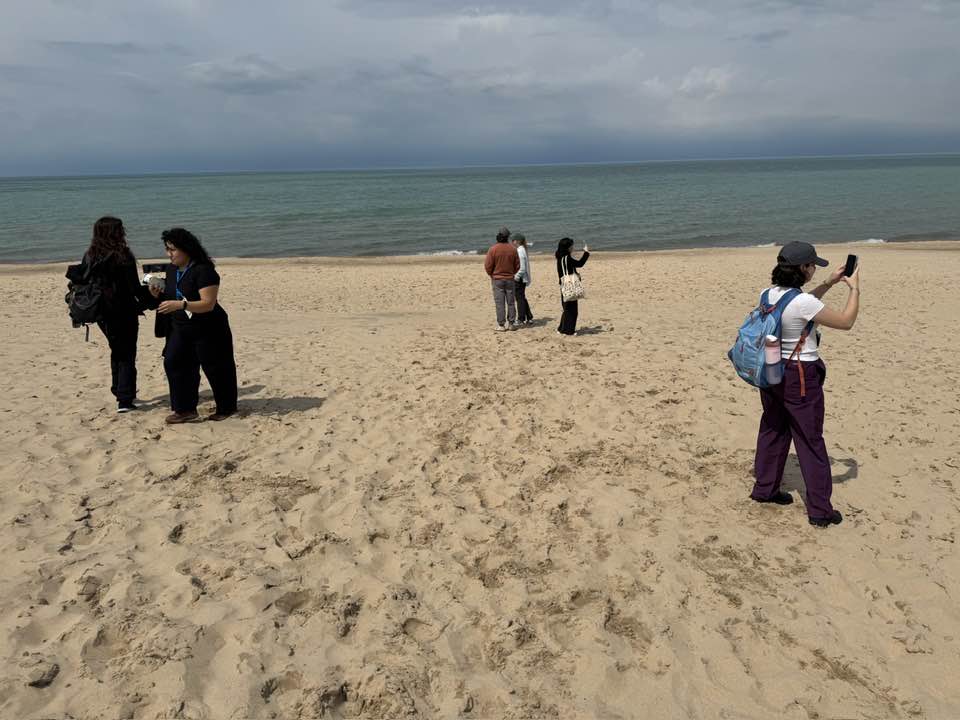 |
| SEJ field trippers randomly wander Lake Michigan beach in search of Indiana Dunes (see column picture of SEJers in 2019 randomly wandering through a Colorado blizzard). Photo: David Helvarg. |
Thursday’s field trips — that will be $85, please — included SEJ’s proud tradition of at least one bus blowing up or breaking down. This one was on the return from the “Silicorn Valley and Dairy Barn” tour when the bus filled with smoke and had to be evacuated (it was probably the ethanol).
It was otherwise a fine tour, full of corn, soy and 200 “chill” cows that the journalists were invited to pet, one of whom (cow, not journalist) gave a rasping lick to Tom Henry’s hand.
I was reminded of another SEJ conference, where a grinning colleague told me she’d had her hand licked by a (guest) wolf, and I suggested perhaps it was more of a tasting.
Other tours included 100 buffalo grazing, urban Superfund sites, a gutted steel town and the Indiana Dunes, whose park headquarters is just across from the U.S. Steel mill, where a brown plume of industrial and sewage pollution discharges from the Little Calumet into Lake Michigan. Luckily, the cadmium neutralizes the E. coli.
The Thursday evening hospitality reception had the usual corporate/NGO offerings of alcohol, snacks, Frank’s hats, etc., though I tried to maintain my journalistic principle that if I drink your vodka and eat your chicken tacos, I won’t talk to you.
Tragically, this year saw a dearth of high-quality free pens (war shortages, I assumed). And after Thursday night, the exhibitors were walled off behind the main hall with nothing to eat but doughnut holes, while the coffee dispensers began migrating around the UIC Forum building.
I was going to stay on for the excerpt of the three-hour PBS Ken Burns film on famed 19th-century content provider and influencer Henry David Thoreau, but when director Erik Ewers explained that “this film is not about Thoreau, it’s about you,” I decided to live deliberately and go to sleep back at the hotel.
Day Three: Is deep dish really pizza?
The morning sessions began at 9 a.m., with panels including “Myths Around Plastics” that included California Attorney General Rob Bonta, who is suing Exxon Mobil over false claims about plastic recycling.
 |
“The one thing recycled by Big Oil and Big Chemical is their lies,” he said, probably not for the first time. But, like plastic, I couldn’t help but think that given his sleek, seamless and lustrous manner, a sea turtle might mistake him for food.
Another panel was titled “Clean Firm Power” and looked into “energy transition beyond solar and wind.” Their options included nuclear power, geothermal and little blue pills.
I was thrilled that the SEJ awards were brought back to the conference lunch and was inspired by the winners, although with the caveat that you need to be a certain (SEJ) type to be pumped by investigative stories about bird killers, teenage oil thieves and transnational dumping of toxic metals.
Afternoon panels included Indigenous perspectives — if you survive one apocalypse, you may have a different viewpoint on the next. Another panel asked, “Can You Make a Living With a Climate Newsletter?” and asserted that, just like professional surfers, Nobel-winning economists and astronauts, you can, depending on who “you” is.
Some attendees claimed that
the sea level rise panel was the
high-water mark of the conference.
Some attendees claimed that the sea level rise panel was the high-water mark of the conference, but I liked “Reporting on Food in the Age of MAHA,” which noted some of the contradictions in the RFK Jr. coalition that supports the president while also believing that regenerative farming, going pesticide-free and eating healthy are still possible under this administration. After all, a famous past leader of Germany was a vegetarian.
Another panel was on climate and culture, and while I’m not one for the culture wars, I will say, having been raised in New York, that, delicious as it is at Giordano’s, deep dish pizza is not pizza — plus it takes more energy to bake.
Also, New York, unlike Chicago, never thought to reverse the flow of its rivers or dye them green. As UIC Chancellor Marie Lynn Miranda said in the day’s last plenary, “Chicago is a beautiful, vibrant, messed-up city.”
At this year’s beat dinners, people talked about toxins and gases over eggplant and cannolis. The organizers of the Population Institute dinner were disappointed that fewer people didn’t show. This was followed by adult beverages, before folks returned to their hotels and safe houses, I mean AirBnBs.
Day Four: One battle after another
I was reminded that this is the 250th anniversary of our nation’s birth, and just as the sinews of our Constitution are being sorely tested, SEJ now rallied a handful of free press-loving patriot members at 7:45 a.m. on a chill April morn to consider a special election for housekeeping bylaw updates.
“Give me board member terms coinciding with the fiscal year or give me death!” No, wait, uh, … OK, at least I’m now convinced (again) that alcohol as a carbon-neutral energy source has its limitations.
The day’s panels included “Social Media: Explaining Earth’s Problems in 60 Seconds” or “We’re F**ked — Cross Post and Make It Fun.” Also, there were two closely related panels — “Data Centers” and “Why the Colorado River Is Running Dry.”
The next set of panels were on the
ocean, food production, fresh water,
environmental justice and the global
environment, so nothing important.
The next set of panels were on the ocean, food production, fresh water, environmental justice and the global environment, so nothing important. I took the time to read a New York Times story on the “underground campaign” to boycott this year’s Met Gala. Dang, I’d just finished selecting my outfit.
There was a final plenary on protecting environmental journalists and the planet that included a couple of scarred old veterans of the ongoing carnage — Time magazine and The Associated Press.
Afternoon mini-tours included driving bikes through urban traffic or taking public transit or possibly an Uber. There was also the pitchfest for those who missed the dolphin feeding at the aquarium, and the book authors panel that might as well have been sponsored by the American Forest and Paper Association. Speaking of dead trees — my new book!
Instead of staying for the final dance party — $60 add-on — with a comic contest and celebrity DJ — I opted for a famous Chicago blues club to avoid, you know, the high school dance raid scene in “One Battle After Another.” Hopefully, they made it through.
And while not meaning to sound too paranoid, having survived the Chicago war zone, I find the selection of the next SEJ conference site pretty darn fishy. See you in Halifax!
David Helvarg’s first SEJ conference was in Ann Arbor in the last century. He’s an author and co-host of the "Rising Tide: The Ocean Podcast." His latest book, which he flogged shamelessly throughout the conference, is “Forest of the Sea – The Remarkable Life and Imperiled Future of Kelp.”
* From the weekly news magazine SEJournal Online, Vol. 11, No. 16. Content from each new issue of SEJournal Online is available to the public via the SEJournal Online main page. Subscribe to the e-newsletter here. And see past issues of the SEJournal archived here.
SEJ Publication Types:
Topics on the Beat:
Visibility: