


SEJournal Online is the digital news magazine of the Society of Environmental Journalists. Learn more about SEJournal Online, including submission, subscription and advertising information.
March 4, 2026
 |
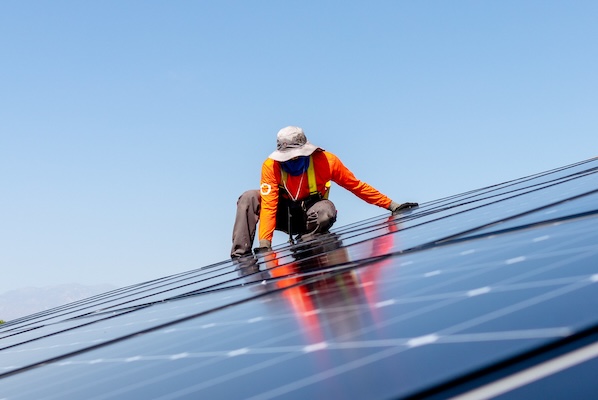 |
| Jobs remain relatively plentiful in the green energy fields, with decent pay and modest training. Above, a solar installation in Palm Desert, California, in 2023. Photo: U.S. Department of Energy/Saman Kouretchian (United States government work). |
TipSheet: Renewable Job Training Makes the Grade at Community Colleges
By Joseph A. Davis
Jobs are hard enough to find in many industries these days — but clean energy is not one of them. Young people looking for opportunity may find it in industries like solar, wind, geothermal, energy efficiency, storage or hydro.
So environmental journalists may want to ask whether their local community college offers technical training for green energy jobs. Some do. Some don’t. It matters.
Yes, there is a raging political battle between the fossil fuel industry forces that dominate the Trump administration and the green energy advocates who hope to save the planet from catastrophic warming.
But TipSheet notes that nobody is building coal plants in the United States anymore. The flood of money unleashed in Biden-era spending bills has not been entirely rescinded.
Why it matters
Jobs are scarce, and young people, in particular, need them.
Jobs — even entry-level jobs — are still relatively plentiful in the green energy fields. You don’t actually need a huge amount of training to install rooftop solar panels. If you have a high school diploma, you can usually get on-the-job training.
The pay is decent (the Bureau of Labor Statistics puts the average at $51,860 per year). It goes up with experience and training.
And, yes, certification and training programs are available and may be useful. See, for example, the offerings of the North American Board of Certified Energy Practitioners.
The opportunities go way beyond
installing solar panels. There are jobs
at all levels in home energy efficiency.
But the opportunities go way beyond installing solar panels. The industry includes electricians, managers and engineers. There are jobs at all levels in home energy efficiency. There are jobs for wind energy professionals — onshore and offshore.
When the oil industry goes flat, drillers can work on geothermal. Elon Musk is putting more money into batteries, now that his Teslas are in the ditch.
But wind turbine maintenance technicians will still be needed.
Story ideas
- Check in with staff at your local community college or equivalent. Look at the course catalog. Do they have vocational courses on rooftop solar installation or other jobs in clean energy?
- Talk to students at your community college. What are their views on clean energy jobs? Do they want such jobs? What paths to such jobs do they see?
- Does your community college or other local organization offer scholarships for young people who want to work in clean energy? Do they offer apprenticeships?
- How many of your community college students want to (or can afford to) go on to a four-year or higher educational institution? Are they interested in green energy?
- Talk to local green energy companies in your area. Whom do they want to hire? Are they having trouble filling some kinds of positions?
- There are many different kinds of clean energy businesses wherever you are. How are they doing profitwise? What kind of pay are they offering to entry-level applicants? To experienced professionals?
- Some places have enterprises that work on community-building around clean energy. An example is “community solar.” What sort of job opportunities do they offer?
Reporting resources
- Solar Energy Industries Association: The SEIA is the main industry advocacy and lobby group.
- American Solar Energy Society: The ASES is a nonprofit NGO that advocates for renewable energy. It offers information, events and resources.
- Solar United Neighbors: This group serves people considering installing solar by offering them information to help with the decision, including telephone counseling, and seeks to build supportive communities.
- National Renewable Energy Laboratory: The NREL used to be a prodigious information resource. Trump renamed it and laid off some staff, but for a while longer, it will be a go-to source.
- American Association of Community Colleges: The AACC is the main advocacy organization for U.S. community colleges, representing more than 1,000 two-year, associate degree-granting institutions.
[Editor’s Note: For more on renewable and other energy sources, check out our Energy topics page, with several dozen SEJournal stories and energy headlines from EJToday.]
Joseph A. Davis is a freelance writer/editor in Washington, D.C. who has been writing about the environment since 1976. He writes SEJournal Online's TipSheet, Reporter's Toolbox and Issue Backgrounder, and curates SEJ's weekday news headlines service EJToday and @EJTodayNews. Davis also directs SEJ's Freedom of Information Project and writes the WatchDog opinion column.
* From the weekly news magazine SEJournal Online, Vol. 11, No. 9. Content from each new issue of SEJournal Online is available to the public via the SEJournal Online main page. Subscribe to the e-newsletter here. And see past issues of the SEJournal archived here.
SEJ Publication Types:
Topics on the Beat:
Region:
Visibility: