


SEJournal Online is the digital news magazine of the Society of Environmental Journalists. Learn more about SEJournal Online, including submission, subscription and advertising information.
June 24, 2026
 |
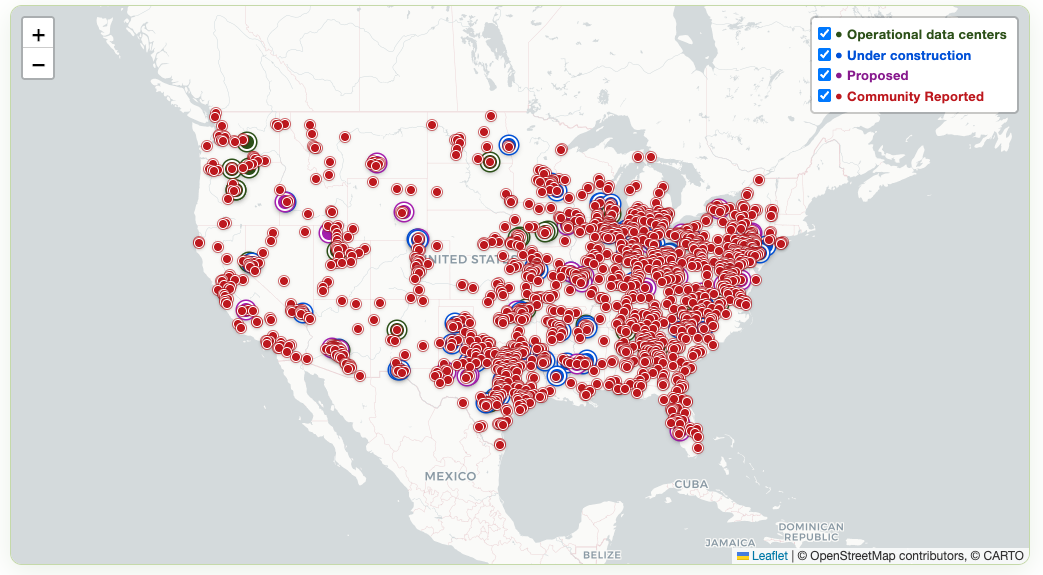 |
| A map from the new Brockovich AI Data Center site shows locales where data centers are already operational, as well as those where they’re under construction, proposed or community-reported. Image: brockovichdatacenter.com |
Reporter’s Toolbox: Databases on Data Centers, Brockovich and Beyond
By Joseph A. Davis
Journalists from The Hollywood Reporter can find data about data centers with Erin Brockovich. And so can environmental journalists.
Maybe Toolbox just has a thing for Julia Roberts (it does). But big-screen inspiration Erin Brockovich is now a superstar for data geeks. Find her new data collection here.
Admittedly, it is a work in progress. But Toolbox gives her credit for shining a brighter light on an important environmental issue.
The artificial intelligence craze may or may not be a tech-bro hype. But the electric power demands, the insatiable water use, greenhouse gas pollution and other environmental harms it does are being eclipsed by the rush to fund, permit and build its giant data centers.
The problem is: The data centers
are being built faster than
journalists can keep up.
Data will help us report on it. The problem is: The data centers are being built faster than journalists can keep up.
Brockovich’s database is right now more ambition than fulfillment. Alarmed citizens are reporting proposed projects faster than Brockovich can record and verify them. Most info in her database comes from citizens. Time promises to complete and fill it out.
At this writing, Brockovich shows 33 centers built and running, 67 under construction, 39 proposed and 5,027 community-reported. That last category is unvetted and likely contains duplications.
Other data sources
One database alternative is compiled and published by the FracTracker Alliance. This is a nonprofit NGO that has advocated against hydraulic fracturing — aka fracking.
The group is better funded and staffed than Brockovich’s. But right now, data centers are not its main focus. Find their database here. Last time we looked, it listed 1,534 facilities (not all of them built). Brockovich has 5,166 entries.
But FracTracker’s contribution is actually in the form of a spreadsheet, which makes it possible for geek-journos to manipulate it for their various special projects.
Yet another relevant database is a commercial product called Data Center Map. It is global in scope, currently listing more than 10,000 facilities worldwide. It costs money — which may put it out of some journalists’ reach. Find their portal here.
It lists 4,353 facilities in the U.S. alone. It also covers Europe, Asia, South America and more. Bring your checkbook.
How to use the data smartly
Your imagination and concerns are ultimately going to develop the data center database story. But the number of facilities matters.
For many, these will be local stories. where national numbers are a peripheral concern.
But there are national and global stories, too. Data centers are worsening the global climate crisis by emitting huge amounts of carbon dioxide and other pollutants. Not to mention slurping up water, which is in short supply locally and regionally.
There will be one near you before you know it. The databases may help you find it. Go to the data center site and talk to people there. Go to the meetings (or protests). Talk to the politicians and regulators. Look up the political contributions.
[Editor’s Note: For more, see our recent Tipsheet on covering data centers’ local emergence, and the latest data center headlines from EJToday. To better understand AI’s impact, check out a two-parter from EJ Academy on assessing its importance in journalism and teaching, along with a WatchDog Opinion column on whether AI will make it easier to limit press freedom and a look at how wildfire disinformation, aided by AI, became a state weapon.]
Joseph A. Davis is a freelance writer/editor in Washington, D.C. who has been writing about the environment since 1976. He writes SEJournal Online's TipSheet, Reporter's Toolbox and Issue Backgrounder, and curates SEJ's weekday news headlines service EJToday and @EJTodayNews. Davis also directs SEJ's Freedom of Information Project and writes the WatchDog opinion column.
* From the weekly news magazine SEJournal Online, Vol. 11, No. 25. Content from each new issue of SEJournal Online is available to the public via the SEJournal Online main page. Subscribe to the e-newsletter here. And see past issues of the SEJournal archived here.
SEJ Publication Types:
Topics on the Beat:
Region:
Visibility: