


SEJournal Online is the digital news magazine of the Society of Environmental Journalists. Learn more about SEJournal Online, including submission, subscription and advertising information.
June 17, 2026
 |
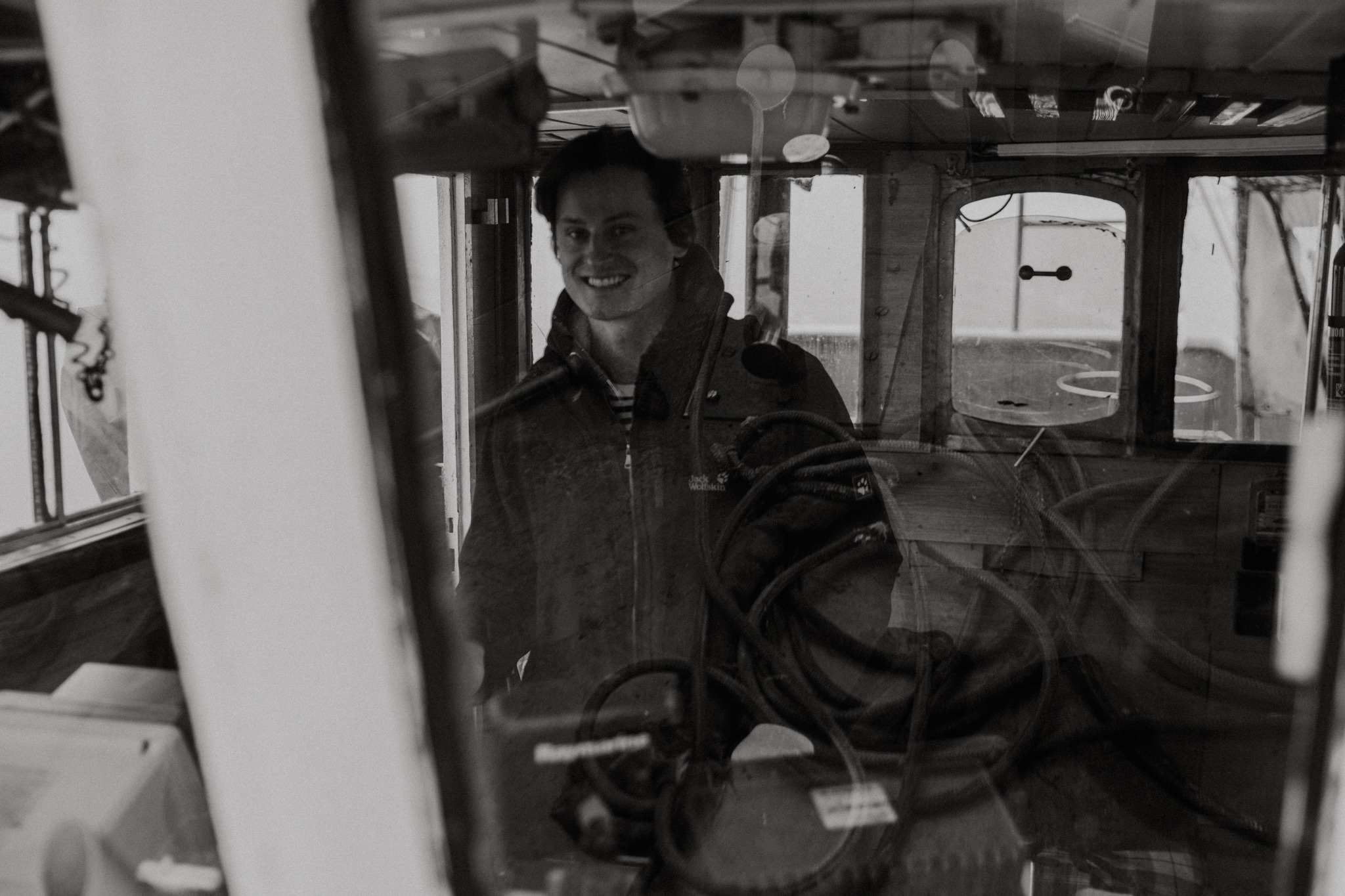 |
| Author Tadeusz Michrowski steers a boat of Antoni Struck, one of his story's characters. Struck left him with the engine full on, while he ran to collect nets. Fortunately, reported Michrowski, there wasn’t much to hit on the open sea. |
Inside Story: Catch-22 on the Baltic — Twilight of Poland’s Coastal Fisherman
Along the Baltic coast of Poland, local fishermen fight for survival as they battle industrial trawlers and the impacts of environmental pollution and climate change. Tadeusz Michrowski, Antonina Chycka and Neil Arun were awarded first honorable mention for outstanding feature story, small, for SEJ’s 23rd Annual Awards for Reporting on the Environment.
Judges were particularly impressed by the way the journalists explained a complex topic in a way that was easy to read: "With solid research, good interviews and lively writing, Tadeusz Michrowski takes readers to Poland's Baltic coast, where a combination of regulatory, environmental and economic challenges is killing off small-scale fisheries.”
SEJournal Online spoke with Michrowski by email. Below is the conversation, edited by Inside Story Co-Editor Rocky Kistner, for clarity and style.
SEJournal: How did you get your winning story idea?
Tadeusz Michrowski: I was looking for something that works well for a solutions journalism story. I thought: “The Baltic Sea is pretty much inside the EU, it's encircled by some of the richest countries in the world. There is overfishing everywhere, but here this must be addressed effectively!” I was wrong. I did some phone interviews and then went to see fishers. It was for a video project, and I remember that we talked for around 30-40 minutes, and all I was thinking about was: “I won't be able to use any of that, the guy is shouting all the time.” From trying to understand this rage, the story idea appeared. The Fellowship for Journalistic Excellence saw its potential and covered the costs.
SEJournal: What was the biggest challenge in reporting the piece/series and how did you solve that challenge?
I wanted people who will trust me
also with the truth, even if that
doesn't put them in a good light.
Michrowski: Getting into the community and whom to rely on in my story were major challenges. Entering a deeply conflicted community that usually is not covered from the outside is pretty hard. I wanted to talk to fishers, not the politicians or professional fisher-activists. I knew that much of the stuff I would hear would be the stuff they know they can tell a journalist. I wanted people who — if they see that I will be fair toward them — will trust me also with the truth, even if that doesn't put them in a good light.
I attended fishers’ meetings: They were open and, honestly, a lot of times they didn't care who came, since I doubt it occurred to them that someone from the outside could be interested. Those meetings took hours and they were not too valuable for a journalist. But it was important to see those dynamics and be aware of them.
The true value came from something else: Some people in those meetings had to be tired of them. Someone who finally stood up and asked: “We are talking about this for two years now. Why does nothing change?” Someone who raised a hand and noted that fishers should admit their mistakes and wrongdoing as well. A person who didn't speak much was sitting in the last rows, but whose name was mentioned with respect for what they did as fishers. Those were the ones I was looking for, and those were the ones I approached later.
It was also valuable in another way: Fishers came to those meetings by car. I could see how their claims of being financially strained fare against the reality of what they drive. So, all of this gave me a good idea of how the community of fishers looks from the inside and helped me find the right people to tell my story.
SEJournal: What surprised you about your reporting/findings?
Michrowski: I started the story with a pretty strong conviction that the third sector may be pretty strong-willed, but acts with a bigger picture in mind. I found one of the world's top NGOs that ignored the fact that their flagship species may be hurting the ecosystem. The most difficult exchanges — at times almost threats — were with the stakeholder I instinctively felt most aligned with before I started to report.
SEJournal: How did you decide to tell the story and why?
Michrowski: The framework was mostly set by the fellowship: It had to be a long read. I could make sure that this story has great visuals, so I brought a photographer. I offered the job to someone who was on her first press commission. She was an amateur photographer specializing in portraits. I had a feeling that this was a story that had to be told through humans, and she could find a way to capture that. Also, since it was her first commission of that type, she was pretty good at making fishers comfortable with her since she had no “professional” aura.
I wanted a ‘no tricks’ story.
I wanted it to tell the story
of coastal fishers in the
simplest way possible.
For writing, I wanted a “no tricks” story. There are a lot of storytelling and journalistic tricks to build tension, creating certain scenes, cutting them in half and doing flashy narratives. I wanted it to tell the story of coastal fishers in the simplest way possible. It turned out to have a lot of conflicts, some of them not obvious. To simplify everything made it better and closer to literature.
SEJournal: Does the issue covered in your story have disproportional impact on people of low income, or people with a particular ethnic or racial background? What efforts, if any, did you make to include perspectives of people who may feel that journalists have left them out of public conversation over the years?
Michrowski: The simplest answer would be “no.” But many of the coastal fishers come from a unique ethnic group, Kashubians, a group that has mostly been reduced to a tourist attraction. The transition in fishing activities failed to take care of those who didn’t want to become reduced to a tourist magnet — whether as Kashubians or just “former fishers.” They were the ones who were left behind and eventually found themselves in a financial strain.
I tried to make sure that I chose my characters from people who are representative of the issues I was writing about. I remember one of them telling me, “You'd rather put us all in the f*ing museum already.” This made me conscious of trying not to romanticize them or describe them through the tropes they don't want to be seen through, like a weekend trip to a past era.
SEJournal: What would you do differently now, if anything, in reporting or telling the story and why?
Michrowski: I had a wonderful editor in Neil Arun. Working with him made me realize how little outside of the topic of interviews and conversations I was noting. I started to observe and put down the initial impressions of a person, their ticks, the way they walk, speak, the way they are, and to think more consciously about what it all means. From that story, I started to show my characters through much more than just their words.
Also, the fellowship turned out to last almost a year longer than planned, and my story appeared almost exactly 12 months after my initial deadline. This meant that I had to forgo planning for publication around a particular event (like the meeting on fishing quotas) and push the story towards something that read well a year later. Unfortunately, I succeeded in more ways than I wanted. Almost two years after publishing, I still learned from the fishers they were in the same spot that they used to be when we first talked.
That's not a story that topples
governments. What made it good
was the depth of it, its nuances.
As for the last part, I see things as they are. I got the honorable mention for a story about problems with fish in a rather obscure region of the world, one not seen as needing coverage. I had no crime, no big corporation to pin to the ground, no North-South abuses or investigation into international political wrongdoing. I had people in a democratic state, within an extremely rich political body, who were unable to make things work despite having pretty much every resource possible. That's not a story that topples governments. What made it good was the depth of it, its nuances, the quality of photos, and the angles that made it feel like it describes issues and mechanisms that not only seem local but global in essence.
I guess the lesson here is you don't need a “sexy” story every time. Sometimes you can do great reporting and find something bigger in a story that may seem small.
SEJournal: What practical advice would you give to other reporters pursuing similar projects, including any specific techniques or tools you used and could tell us more about?
Michrowski: Use time to your advantage and care about people who trust you — they will pay you back. It took 18 months from my first interview to the moment the story was published. A lot of information I didn't get in the meetings, during fishing trips or interviews, I learned over the casual phone calls with the characters from my story. It doesn't cost much to follow up every now and then, ask how they are or send holiday greetings.
This was a great privilege related to the great frustration of having to work so long on that story. But to be in someone's life for so long is an incredible value for a journalist — you get to witness how they change, grow and how the issues they face affect them over time. It makes for good journalism.
Keep an open mind about
things that sound crazy, but
make sure you have a trusted,
legit scientist to confirm it.
Also, keep an open mind about things that sound crazy, but make sure you have a trusted, legit scientist to confirm it. The idea that seals became a factor in the cod destruction sounded ridiculous. But it turned out to be a pretty big scientific consensus that doesn't get covered.
For tools: Pulitzer Center’s Ocean Reporting Toolkit. Also, I wish AI was a thing when I wrote my story! Use it. Not as a source but as a tool to find obscure but valuable data. It can be very hard to find data on court cases about overfishing in particular regions through regular searches. But AI is very useful in finding those obscure, hard-to-find repositories. You don't rely on AI for data; you rely on it to help you find where the data may be.
SEJournal: Could you characterize the resources that went into producing your prizewinning reporting (estimated costs, i.e., legal, travel or other; or estimated hours spent by the team to produce)? Did you receive any grants or fellowships to support it?
Michrowski: I received a Fellowship for Journalistic Excellence grant, which was 3,000 euros, paid in three parts. The story cost around 1,000-1,500 euros, including gasoline, accommodation and food, the rest for my remuneration (I was prohibited from taking any money for published stories). The photographer took 150 euros for half a day’s work. Neil Arun spent many hours on the calls with me while editing the story. I'm not sure about his remuneration.
But it was a very cheaply produced story. I tried to go mostly offseason to visit my characters, and whenever possible, I tried to hop in a car with a family member or a friend who was going in that direction anyway. I ate frozen pizzas from microwave ovens while there to save money.
Tadeusz Michrowski is an award-winning Polish journalist with a focus on the Global South and climate change. His work is featured in publications such as New Lines Magazine, Balkan Insight and Frontstory.pl. Michrowski is a recipient of a Covering Climate Now Journalism Award and was nominated for multiple other awards.
* From the weekly news magazine SEJournal Online, Vol. 11, No. 24. Content from each new issue of SEJournal Online is available to the public via the SEJournal Online main page. Subscribe to the e-newsletter here. And see past issues of the SEJournal archived here.
SEJ Publication Types:
Topics on the Beat:
Region:
Visibility: