


SEJournal Online is the digital news magazine of the Society of Environmental Journalists. Learn more about SEJournal Online, including submission, subscription and advertising information.
May 27, 2026
 |
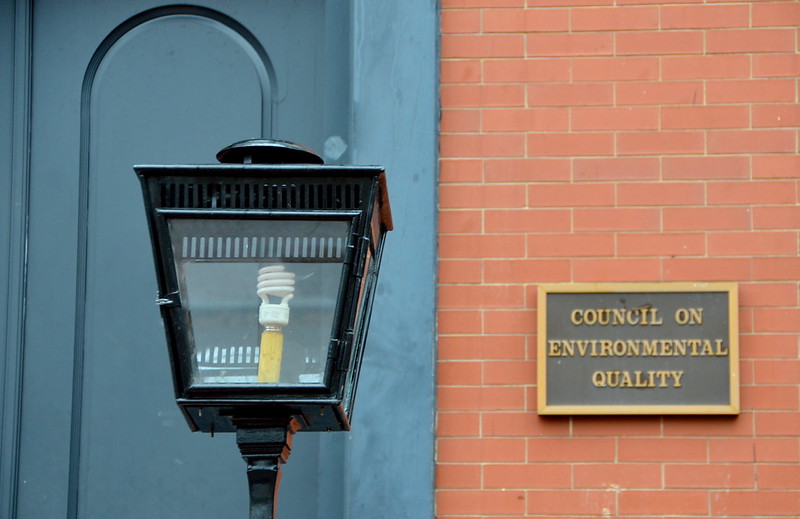 |
| Will a new Trump administration stance on presidential documentation leave the public in the dark about how executive office agencies like the Council on Environmental Quality, which oversees environmental impact statements needed for many federal projects, makes its decisions? Photo: Adam Fagen via Flickr Creative Commons (CC BY-NC-SA 2.0). |
WatchDog Opinion: Why Environmental Journalists Should Care About the Presidential Records Act
By Joseph A. Davis
The latest Trump outrage against freedom of information is not just unconstitutional. It’s illegal.
President Trump's Department of Justice is claiming that the 48-year-old Presidential Records Act is allegedly unconstitutional. It is, in fact, constitutional. And it requires presidential records to be preserved as property of the federal government.
What the DOJ wants to do is to outlaw the law that Trump was charged with violating when he stored boxes of highly classified documents in the bathroom at Mar-a-Lago. The charges were dropped only after Trump was reelected.
What is the act and why do we need it?
The act was proposed after resigned President Richard Nixon sought to destroy evidence — such as the Watergate tapes — of his corrupt presidency. He resigned in 1974, and the law was finally enacted in 1978.
The whole idea was to preserve
evidence, whether of despicable
crimes or praiseworthy achievements.
The whole idea was to preserve evidence, whether of despicable crimes or praiseworthy achievements. At least for the future presidential libraries.
The full text of the act can be found here. It is long and complicated. A decent summary by the National Archives and Records Administration is here.
In essence, the PRA gives the president custody of the records of his presidency while in office — but gives ownership of the records to the National Archives. It establishes criteria and procedures for getting rid of unneeded records, but that requires approval by NARA.
The legal document by which Trump’s highly politicized DOJ attempted to usurp Congress’ legislative authority was an opinion by the DOJ’s Office of Legal Counsel. OLC has no actual authority to enact or repeal legislation. Find the full 52-page text of OLC’s opinion here.
Yet OLC opinions do in practice get some deference — if only because they advise Justice Department actions.
Why it matters to environmental reporters
It’s not just Trump’s records at stake. Many of the things that environmental journalists report on involve the president and his/her immediate staff.
 |
Some presidents are very involved in environmental issues. Look at Jimmy Carter donning a sweater and putting solar panels atop the White House. Look at Vice President Dick Cheney taking over climate and energy policy (the act applies to VPs as well). Look at President Obama’s engagement in the Paris climate accord.
The Presidential Records Act applies not only to the president, but to a rather vaguely defined set of close advisers. The law does not list them.
WatchDog assumes that they include the staff of the Council on Environmental Quality, part of the Executive Office of the President. They oversee most federal agencies and among their duties is to oversee environmental impact statements — needed for many big federal actions affecting the environment.
Farther offstage and harder to see is the Office of Information and Regulatory Affairs at the Office of Management and Budget. OIRA must review and approve virtually every major federal regulation before it is issued. It holds semisecret meetings with industry lobbyists, as well as with green groups.
The act must apply to many communications involving the chief of staff. So if Susie Wiles or Stephen Miller gets (or writes) a note saying “deregulate that chemical,” it is covered.
Where did the head of OIRA go?
Remember Jeffrey Clark? He makes a good case for the need for the Records Act.
During Trump 1.0, he was assistant attorney general for the DOJ’s Environment and Natural Resources Division. The unit prosecutes most of the violations of laws identified by the U.S. Environmental Protection Agency. But not always.
In that position, Clark worked against the enforcement of climate regulations. Then Clark took part in Trump’s effort to overturn the 2020 election. He was an unindicted co-conspirator in the federal case and a defendant in the Georgia case. Ultimately, he lost his law license.
That, however, did not keep Trump 2.0 from naming him head of OIRA (it didn’t hurt that Trump OMB director Russell Vought was Clark’s friend).
Clark served in acting and temporary capacities for a year — orchestrating Trump’s massive deregulation. It was Clark, for instance, who wrote the memo forbidding agencies from using the social cost of carbon.
The post does need to be confirmed by the Senate, however, so Clark left in early March. So this disbarred insurrectionist ultimately avoided embarrassing confirmation hearings.
Clark’s correspondence on
Trump’s federal-wide deregulation
rampage would be protected
from disclosure as well.
Clark’s correspondence on Trump’s federal-wide deregulation rampage would be protected from disclosure as well, under the DOJ’s new reading of the records act. Eat your hearts out, investigative journalists.
‘Essential to democratic processes’
Historians have already sued over the act. In their filing of April 14, they asked for an immediate injunction to keep the DOJ's move from going into effect.
“The preservation of these records, both current, past and future, are all essential to democratic processes that depend upon appropriate public scrutiny,” stated Sarah Weicksel, executive director of the American Historical Association.
The association was joined in its lawsuit by the nonprofit democracy watchdog group American Oversight.
The WatchDog also knows of two press freedom groups publicly objecting, with a suit against the DOJ’s move. And on May 20, a federal court granted the groups an emergency preliminary injunction, halting the administration’s efforts, at least for now, and forcing it to preserve presidential records while the case works its way through the legal system. Watch this space!
Joseph A. Davis is a freelance writer/editor in Washington, D.C. who has been writing about the environment since 1976. He writes SEJournal Online's TipSheet, Reporter's Toolbox and Issue Backgrounder, and curates SEJ's weekday news headlines service EJToday and @EJTodayNews. Davis also directs SEJ's Freedom of Information Project and writes the WatchDog opinion column.
* From the weekly news magazine SEJournal Online, Vol. 11, No. 21. Content from each new issue of SEJournal Online is available to the public via the SEJournal Online main page. Subscribe to the e-newsletter here. And see past issues of the SEJournal archived here.
SEJ Publication Types:
Topics on the Beat:
Region:
Visibility: