


SEJournal Online is the digital news magazine of the Society of Environmental Journalists. Learn more about SEJournal Online, including submission, subscription and advertising information.
March 11, 2026
 |
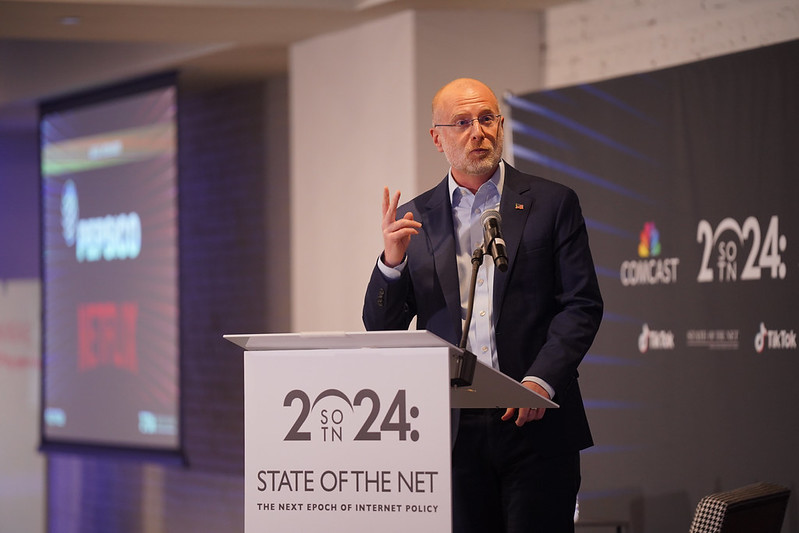 |
| The Trump administration has been using regulatory powers to coerce some Big Media, argues WatchDog Opinion. Above, FCC Chair Brendan Carr, who extracted concessions from CBS before a corporate merger. Photo: Internet Education Foundation via Flickr Creative Commons (CC BY 4.0). |
WatchDog Opinion: Press Freedom Erosion Continues Apace Under Trump 2.0
By Joseph A. Davis
 |
Donald Trump’s war on press freedom continued during the first year of his second administration. He loves media attention — but won’t stop undermining the First Amendment.
Sadly, some media play along.
It’s been a long year. The good news is that Times v. Sullivan — a key bulwark protecting journalists from meritless libel suits — is still intact. The Supreme Court justices who want to end it are still a minority.
This hasn’t stopped Trump from filing libel suits. The nuisance is the point.
A major piece of bad news, however, is that he has discovered some effective new tools for attacking the “enemy of the people.” They exploit a growing vulnerability of today’s media: the fact that they are increasingly owned by billionaires and large corporations.
The nuisance libel suit is one that is filed with no hope of winning — its main point is to impose legal expenses, intimidate the defendant, deny an accusation and win headlines.
When the Wall Street Journal in July 2025 broke the story of Trump’s bawdy addition to Jeffrey Epstein's “birthday card,” Trump declared no such thing existed — and sued them for $10 billion (that’s billion with a “b”). It was embarrassing when House Democrats on the Oversight Committee later released the birthday message.
In September 2025, Trump filed a $15 billion libel suit against The New York Times and four of its reporters who reported criticism of him. A judge threw it out for bloviation.
In December 2025, Trump filed a $10 billion defamation suit against BBC News over how it edited his Jan. 6, 2021, speech to the crowd that later stormed the Capitol. It hasn’t been resolved.
So it goes. Times v. Sullivan is still safe. Trump critics, not so much.
Weaponizing FCC, FTC
Another Trump weapon against critical media is his use of regulatory power against big megabillion corporate conglomerates that are trying to get mergers or licenses though the Federal Communications Commission or the Federal Trade Commission.
A prime example was CBS. Once the home of Walter Cronkite, “the most trusted man in America,” CBS in 2025 was going through the process of getting bought up and losing its credibility.
The history of CBS is too long and complicated to recount here. It was trusted for many years when it was majority-owned by William Paley. Shows like “60 Minutes” with Mike Wallace earned great respect for their hard-hitting investigative journalism.
CBS was later subsumed under Viacom, which was put under Paramount in 2019. Many media companies considered buying Paramount, but it was eventually merged in a deal with Skydance in 2025. This required approval by the FCC.
At the moment when the merger was before the FCC, CBS announced that Stephen Colbert’s late-night show was being terminated. Colbert had satirized Trump. Since he was not scheduled to leave before May 2026, he has joyfully continued to lampoon Trump in the meantime.
FCC Chair Brendan Carr let it
be known that he had extracted
concessions from CBS before
the merger. He called it ‘reform.’
But the FCC, under Trump-appointed Chair Brendan Carr, let it be known that it had extracted concessions from CBS before the merger. Carr called it “reform.”
One manifestation of reform was the appointment of Bari Weiss (subscription required) as editor-in-chief of CBS News. Another was some high-profile departures of good journalists from CBS.
Something similar happened with ABC late-night comic Jimmy Kimmel. His sin was to speak less-than-worshipfully about right-wing demigod Charlie Kirk. With encouragement from Carr, ABC suspended the show.
Huge protests from many quarters erupted, not only against ABC but against its parent, Disney. Kimmel’s show was restored, and he continued to lampoon Trump as well as his own network. The FCC’s Carr had at the time been investigating Disney for allegedly pursuing diversity, equity and inclusion policies.
Trump-corporate ties — or puppet strings?
The WatchDog concludes that the Trump 2.0 administration uses its regulatory power over corporations to coerce them to publish certain kinds of content and to suppress other kinds. That’s Trump’s big innovation.
But this strategy only works with big corporations and works especially well when those corporations have ties — whether personal, economic or political — to Donald Trump.
And apropos of that, you may remember that CBS Paramount was eventually gobbled up by top Trump donor Larry Ellison’s family conglomerate. The FCC smiled upon the deal.
One corollary to all this is that small, personal, independent and often nonprofit media are the best path forward to quality, truthful coverage of public affairs.
This seems especially true for environmental journalism. You won’t hear much about climate change or toxic discharges on the cable nets — even the good ones. Look instead to ProPublica, Public Domain, Inside Climate News and myriad others like them. Of course, the problem remains of finding ways for good journalists to get paid.
Joseph A. Davis is a freelance writer/editor in Washington, D.C. who has been writing about the environment since 1976. He writes SEJournal Online's TipSheet, Reporter's Toolbox and Issue Backgrounder, and curates SEJ's weekday news headlines service EJToday and @EJTodayNews. Davis also directs SEJ's Freedom of Information Project and writes the WatchDog opinion column.
* From the weekly news magazine SEJournal Online, Vol. 11, No. 10. Content from each new issue of SEJournal Online is available to the public via the SEJournal Online main page. Subscribe to the e-newsletter here. And see past issues of the SEJournal archived here.
SEJ Publication Types:
Topics on the Beat:
Region:
Visibility: