


SEJournal Online is the digital news magazine of the Society of Environmental Journalists. Learn more about SEJournal Online, including submission, subscription and advertising information.
February 18, 2026
 |
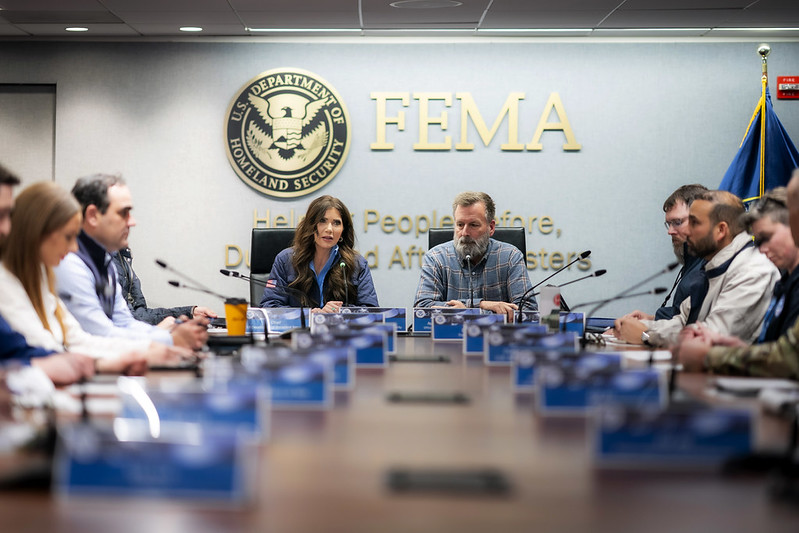 |
| Homeland Security Secretary Kristi Noem has taken much of the blame for unpaid federal disaster aid. Noem, above at center left, participates in a FEMA briefing in Washington, D.C., on Jan. 25, 2026. Photo: Department of Homeland Security/Tia Dufour via Flickr Creative Commons (United States government work). |
TipSheet: Is Disaster Aid Backlog Becoming a (Blue State) Disaster?
By Joseph A. Davis
 |
Many of today’s disasters in the United States fall to environmental journalists to cover because they are climate-related: floods, hurricanes, wildfires, etc.
But if disasters are news, so is the question of post-disaster aid to survivors coming from the Federal Emergency Management Agency. These days, that aid seems to be flowing more readily to red states than blue ones. And the backlog of expected but unpaid federal disaster aid has been steadily growing.
Kristi Noem, secretary of the Department of Homeland Security, has been first in line for much of the blame. That’s because DHS oversees FEMA. But Donald Trump and his administration have been broadly hinting, since his second inauguration, that he wanted to eliminate or restructure FEMA and turn the main responsibility for disaster aid over to the states.
States have not welcomed this. The National Governors Association pointedly avoided recommending any reduction of federal funds in a key May 2025 letter on FEMA reform. It did recommend stronger state and local leadership.
Why it matters
People who undergo disasters — if they are lucky enough to escape with their lives — often find their homes (or businesses) destroyed and have nowhere to go but a neighbor’s couch or a high school gym.
It’s major, multitrauma, prolonged human misery. Sometimes, whole towns are destroyed.
The thing about big disasters is that
a town — or even a state — may
no longer have enough resources
to help itself and recover.
The thing about big disasters is that a town — or even a state — may no longer have enough resources to help itself and recover.
Disaster aid is based on the principle of neighbors helping neighbors: a foundation of human decency that goes way, way back in the history (even prehistory) of civilization. And religion.
The backstory
States have been engaged in disaster response for a long time. As governors said last November, “FEMA becomes a critical partner when an event surpasses states and territories’ capacity to respond on their own.”
But the Trump-Noem FEMA hasn’t exactly rushed to help. In fall 2025, according to the National Association of Counties, the FEMA backlog of disaster reimbursements was over $11 billion.
The New York Times has put the backlog at as much as $17 billion (may require subscription). Noem has been blamed by critics for the pileup, because she has insisted on unusually time-consuming extra reviews.
The question arises as to whether
the Trump administration is delaying
more aid to blue states than red states.
The question arises as to whether the Trump 2.0 administration is delaying more aid to blue states than red states. MS NOW producer Steve Benen reports that they have indeed.
The list of recent aid-receiving red states includes Mississippi, Kansas, Montana and Missouri. Blue states complaining of aid denied or delayed include Illinois, Maryland, Vermont and Colorado.
Story ideas
- What major disasters has your state experienced in recent years? Did the state and residents receive federal disaster aid? How long did it take? Did they receive the full amount requested?
- Other federal agencies besides FEMA offer disaster aid. Check out your state’s experience with the Small Business Administration, the Agriculture Department or the Department of Housing and Urban Development.
- What would or could your state do in the case of a total cutoff of federal disaster aid?
- Talk to your state’s governor, senators and representatives (or their staffs) about their efforts to get federal disaster aid.
- Talk to people in your state whose homes have been damaged or lost about their experiences.
Reporting resources
- Federal Emergency Management Agency: FEMA is the federal government body supposed to provide assistance to help people before, during and after a disaster.
- FEMA Review Council: This is the Trump FEMA task force studying agency reform. See the CNN Report summarizing the suppressed draft report of the council.
- Disaster Response Reform Task Force: This is a bipartisan task force of experts not currently employed at FEMA who have been studying FEMA reform.
- Association of State Floodplain Managers: An association of state officials who deal with flood disasters.
- National Governors Association: A bipartisan association of governors of all 50 states. Also see its Public Health and Emergency Management Task Force.
[Editor’s Note: See winter storm reporting resources from SEJ Publications and a Feature on how to prepare for weather disaster reporting. And for more, visit our Topic on the Beat page on Disasters, plus see the latest disaster-related headlines from EJToday.]
Joseph A. Davis is a freelance writer/editor in Washington, D.C. who has been writing about the environment since 1976. He writes SEJournal Online's TipSheet, Reporter's Toolbox and Issue Backgrounder, and curates SEJ's weekday news headlines service EJToday and @EJTodayNews. Davis also directs SEJ's Freedom of Information Project and writes the WatchDog opinion column.
* From the weekly news magazine SEJournal Online, Vol. 11, No. 7. Content from each new issue of SEJournal Online is available to the public via the SEJournal Online main page. Subscribe to the e-newsletter here. And see past issues of the SEJournal archived here.
SEJ Publication Types:
Topics on the Beat:
Region:
Visibility: